Blog

  • Custom Book Illustration Services: How the Right Art Transforms Your Book

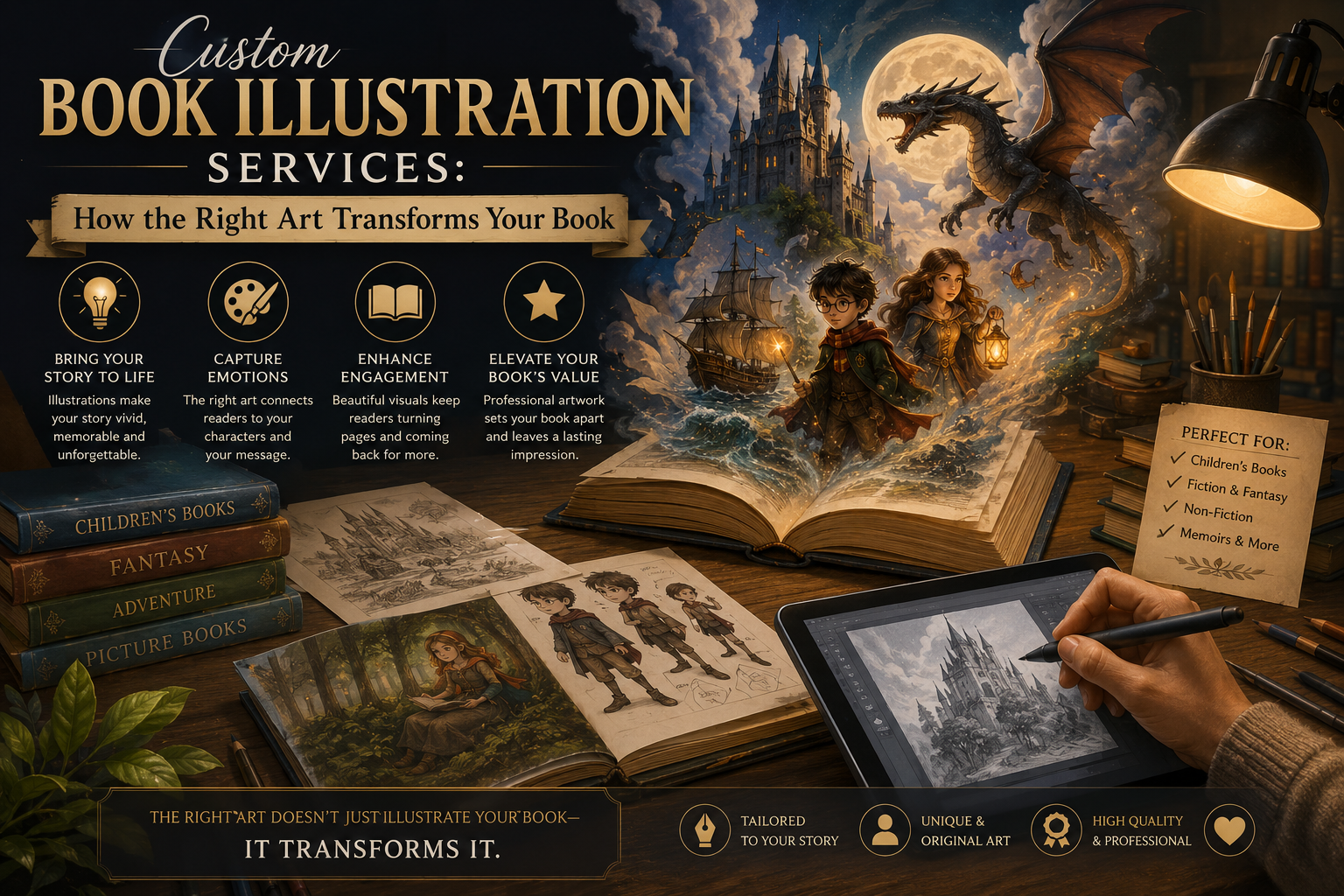
    Custom Book Illustration Services: How the Right Art Transforms Your Book

    Walk into any bookstore — or scroll through any section of Amazon — and pay attention to what your eyes do. They don’t read titles first. They see images. A cover catches your eye before a single word registers. An illustration stops your scroll in a feed of text. Art communicates what prose takes paragraphs to establish: tone, genre, emotional register, and quality — all in a fraction of a second.

    Professional book illustration isn’t decoration. It’s a fundamental component of your book’s ability to attract, engage, and retain readers — and in 2026, it’s one of the most significant differentiators between books that get noticed and books that don’t. This guide covers what custom book illustration services involve, where illustration adds the most value, how to choose the right illustrative style for your project, and what to expect from the professional illustration process.

    What Is Custom Book Illustration?

    Custom book illustration refers to original artwork created specifically for your book — not stock images, not AI-generated graphics, not adapted clip art, but professionally crafted visual work designed to serve your book’s specific needs. Custom illustration encompasses:

    • Cover design and illustration — the primary image that represents your book to the world
    • Interior spot illustrations — images placed throughout the text to break up content, reinforce ideas, or carry the narrative
    • Full-page interior illustrations — particularly common in children’s books, picture books, and visually-driven non-fiction
    • Character design and development — establishing consistent visual identities for recurring characters
    • Maps, diagrams, and informational graphics — for non-fiction, educational, and reference titles
    • Chapter header art — decorative or thematic illustrations that open each chapter

    The scope of illustration work varies enormously by book type. A children’s picture book may require 24–32 full-color spreads. A business non-fiction title may need only a custom cover and a handful of interior diagrams. A fantasy novel may benefit from a map, chapter headers, and a distinctive cover. Understanding what your specific book needs — and what each type of illustration contributes — is the starting point for a smart illustration investment.

    Where Illustration Makes the Biggest Difference

    Illustration

    Children’s Books and Picture Books

    In no book category is illustration more central to the product than children’s books. For picture books (typically ages 3–8), the illustrations don’t just accompany the story — in most cases, they carry it. The text and images work together as equal storytelling partners, with the illustrations often conveying information, humor, and emotional depth that the sparse text doesn’t express.

    For parents and educators selecting books, the illustration style is frequently the primary decision factor. Does the artwork feel warm and inviting? Does it have the right energy for the age group? Does it match the emotional tone of the story? A poorly illustrated children’s book — or one illustrated in a style mismatched to its story — is simply not competitive in today’s market, regardless of the quality of the writing.

    Non-Fiction and Educational Books

    Non-fiction books benefit from illustration in ways that are often underappreciated by first-time authors. Diagrams and infographics make complex information accessible to readers who struggle with dense text. Charts and data visualizations turn abstract numbers into immediate understanding. Maps and timelines provide spatial and chronological context that prose alone cannot efficiently deliver.

    Beyond purely informational graphics, custom illustrations in non-fiction signal craft and investment. A self-help book with thoughtfully illustrated chapter headers communicates attention to detail. A business book with custom diagrams that visualize the author’s framework looks and feels more authoritative than one with generic stock imagery or bare text.

    Business and Professional Books

    For executives and professionals publishing books to build their authority and brand, illustration plays a different but equally important role. Your book is a direct extension of your professional brand — and the visual quality of that book communicates something immediate about the quality of your thinking and the care you invest in your work.

    A professionally illustrated cover that commands attention and communicates expertise positions you differently than a generic design. Custom framework diagrams that visualize your methodology become memorable, shareable, and replicable — they’re the visual vocabulary of your ideas. And a consistent visual identity across your book, your website, and your marketing materials signals the professionalism of a serious author brand.

    Fiction and Literary Books

    While much adult fiction relies primarily on typographic cover design rather than illustrated covers, illustrated covers have seen a significant resurgence across multiple fiction genres — particularly fantasy, science fiction, literary fiction, and romance. A distinctive illustrated cover that immediately communicates genre and tone can be a powerful differentiator in a crowded genre marketplace.

    For fiction series, character illustrations, world maps, and symbolic imagery create a visual universe that deepens reader attachment to the story and its world. Limited illustrated editions and collector’s editions increasingly rely on custom artwork as a key value driver.

    Understanding Illustration Styles: Matching Art to Your Book

    Choosing the right illustration style is one of the most important creative decisions in the illustration process. Style sets the emotional register of your book and communicates directly to your target reader before they’ve read a word. Here’s a framework for the most common illustration styles and where each works best:

    Illustration StyleCharacteristicsBest Suited For
    Whimsical / CartoonishRounded shapes, bright colors, expressive characters, playful energyChildren’s picture books (ages 2–8), lighthearted non-fiction, humor-driven content
    Realistic / Semi-RealisticDetailed rendering, accurate proportions, naturalistic color palettesYoung adult, literary fiction, professional non-fiction, memoirs
    Flat / Graphic / VectorClean lines, limited color palettes, modern aesthetic, scalableBusiness books, infographics, educational content, covers for professional titles
    Watercolor / Hand-PaintedSoft edges, organic textures, painterly quality, warmthChildren’s books (ages 4–10), literary fiction, books with a handcrafted or artisanal feel
    Ink / Line ArtBold outlines, high contrast, graphic quality, timeless feelClassic children’s books, literary titles, specialty editions, chapter headers
    Digital PainterlyRich color, high detail, cinematic quality, dramatic lightingFantasy, sci-fi, epic fiction covers; high-concept non-fiction
    Infographic / Data VisualizationCharts, graphs, diagrams, icons, structured information designBusiness, self-help, educational, how-to, and reference non-fiction
    The Style Matching Principle Your illustration style should feel inevitable — as if no other style could possibly have been right for this book. The best way to identify the right style is to gather reference images of books in your genre and price point that you admire, and look for patterns in the illustration approach. Your illustrator will use these references as a creative brief.

    The Custom Illustration Process: What to Expect
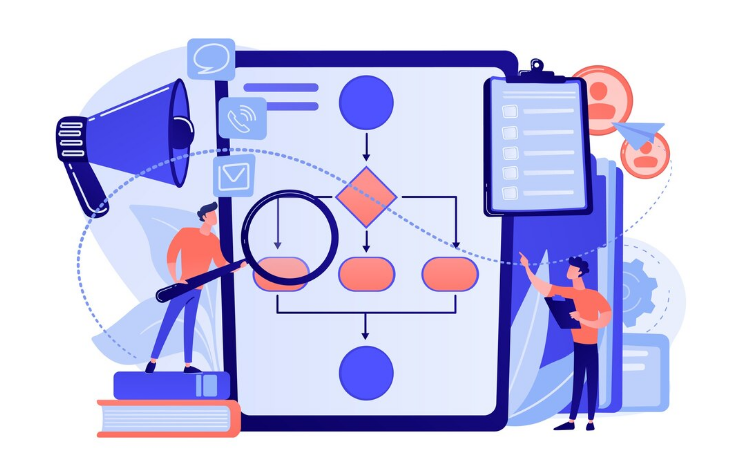
    Illustration process

    Professional book illustration is a collaborative process with defined phases. Understanding what happens at each stage helps you prepare, contribute effectively, and avoid the most common sources of delay and frustration.

    Phase 1: Brief and Discovery

    The process begins with a comprehensive creative brief. Your illustrator needs to understand: the book’s genre and audience, the overall tone and emotional feel you’re aiming for, the specific scenes, characters, or concepts that need to be visualized, any style references you’ve gathered, and any brand or identity considerations that need to be reflected in the artwork.

    The more specific and visual your brief, the more efficient the illustration process will be. Illustrators are not mind-readers — they work from the information you give them. A detailed brief with reference imagery and specific direction produces better initial concepts and requires fewer revision rounds than a vague one.

    Phase 2: Initial Concepts and Sketches

    Your illustrator produces initial sketches or concept explorations — rough, small-scale drawings that establish the composition, character positioning, and overall visual direction without investing in full rendering. This is the most critical review stage. Feedback at the sketch phase is fast and inexpensive to act on. Feedback after full rendering is expensive and slow.

    Review sketches carefully. Confirm that the composition, character expressions, and spatial relationships are right before approving the move to final artwork. This is also the time to flag any factual or contextual issues — a character’s appearance, a setting’s details — that would be harder to correct in the finished illustration.

    Phase 3: Rendering and Color

    With sketches approved, the illustrator moves to full rendering — adding detail, texture, and color to produce the finished artwork. For digital illustration, this is done entirely in software; for traditional media, the physical work is completed and scanned at high resolution for reproduction.

    At this stage, feedback should focus on refinements rather than structural changes. Requesting a composition change at the rendering stage is expensive and disrupts the project timeline significantly. Trust the sketch approval process to catch large structural issues; use the rendering review for color, mood, and detail adjustments.

    Phase 4: File Delivery and Print Preparation

    Finished illustrations are delivered in formats appropriate for print and digital use: typically high-resolution TIFF or PNG files for interior illustrations, and layered source files for cover artwork that needs to be adapted for different formats (ebook, print-on-demand, audio, etc.). For print books, your illustrator or publishing team will ensure color profiles, resolution, and bleed specifications meet the requirements of your chosen printer.

    Illustration Cost Overview

    Illustration costs vary significantly based on the type of book, the scope of work, the illustrator’s experience, and the medium. Here is a realistic reference range for 2026:

    Scope of WorkTypical Cost Range (2026, USA)
    Custom cover illustration only (no interior)$800–$5,000+
    Children’s picture book (24–32 full-color spreads)$6,000–$25,000+
    Board book (10–16 full-color spreads)$3,000–$10,000
    Chapter book (spot illustrations throughout)$2,000–$8,000
    Non-fiction interior diagrams / infographics (set of 10)$1,500–$6,000
    Business book framework diagrams (set of 5–8)$1,000–$4,000
    Character design and style guide$800–$3,000
    Chapter header illustrations (set of 10–15)$1,000–$3,500

    These ranges reflect professional-quality work from experienced illustrators. Offshore rates may be lower, but quality, communication, and adherence to project briefs vary significantly. For a book attached to a serious publishing or professional brand, investing in a skilled, experienced illustrator is almost always worth the premium.

    Frequently Asked Questions

    How do I know if my book needs illustration?

    The clearest indicator is your book’s genre and audience. Children’s picture books and illustrated chapter books require illustration by definition. For other categories, ask: would visual elements make this book significantly easier to understand, more emotionally engaging, or more competitive in its market? For most non-fiction, business books, and professional titles, the answer is yes for at least the cover and potentially for interior elements. A consultation with a publishing professional can help you assess the right scope.

    Can I use AI-generated art instead of a professional illustrator?

    AI-generated imagery can serve as a starting point for conceptual exploration, but it is not a substitute for professional illustration in published books intended for commercial distribution. Beyond quality and consistency limitations, AI image generation raises significant copyright and licensing questions that are still being resolved legally in the US and internationally. Professional publishers and distributors increasingly require confirmation that cover and interior artwork was created by human artists. For a book representing your professional brand, AI-generated art carries reputational risks that professional illustration does not.

    How long does the illustration process take?

    Timeline depends on the scope of work. A single cover illustration typically takes two to four weeks. A complete children’s picture book with 24–32 spreads typically takes three to five months. Non-fiction interior illustrations (diagrams, infographics) typically take four to eight weeks depending on complexity and volume. Build illustration timelines into your publishing schedule early — rushing illustration produces worse results and costs more in revisions.

    Who retains the rights to commissioned illustration?

    In a standard work-for-hire arrangement, the commissioning party (you, the author or publisher) owns all rights to the artwork upon full payment. The illustrator retains no rights to use the work commercially. This should always be explicitly confirmed in your contract before work begins. Some illustrators offer non-exclusive licensing arrangements at lower rates, which means they retain the ability to use the artwork in other contexts — typically not appropriate for book cover art.

    How does Bookpress Publications coordinate illustration with the rest of the publishing process?

    Bookpress Publications manages illustration as an integrated part of the full publishing process, not as a separate service to be coordinated externally. Our illustration team works alongside your editor and production team, so cover art is developed in alignment with your book’s marketing position, interior illustrations are timed correctly within the overall production schedule, and all artwork is delivered in the correct formats for your distribution channels. This integration eliminates the coordination overhead that comes from managing independent contractors across different stages of the process.

    Art That Does the Work Before the Words Start

    The illustration decisions you make for your book aren’t aesthetic choices in isolation — they’re strategic ones. The right cover illustration gets your book clicked on. The right interior art makes your ideas more memorable. The right character design creates the emotional connection that turns readers into fans.

    In a publishing landscape where thousands of new titles are released every week, visual quality is not a secondary consideration. It is a primary competitive factor — and one that professional illustration services make accessible to every author at every level.

    Bookpress Publications offers custom book illustration services for children’s books, non-fiction, professional titles, and cover design across all genres. Book a free consultation to discuss your book’s visual needs, explore illustration styles, and get a clear picture of what a professional illustration partnership would look like for your specific project.

  • How to Market Your Book Before It’s Published: 10 Strategies That Work

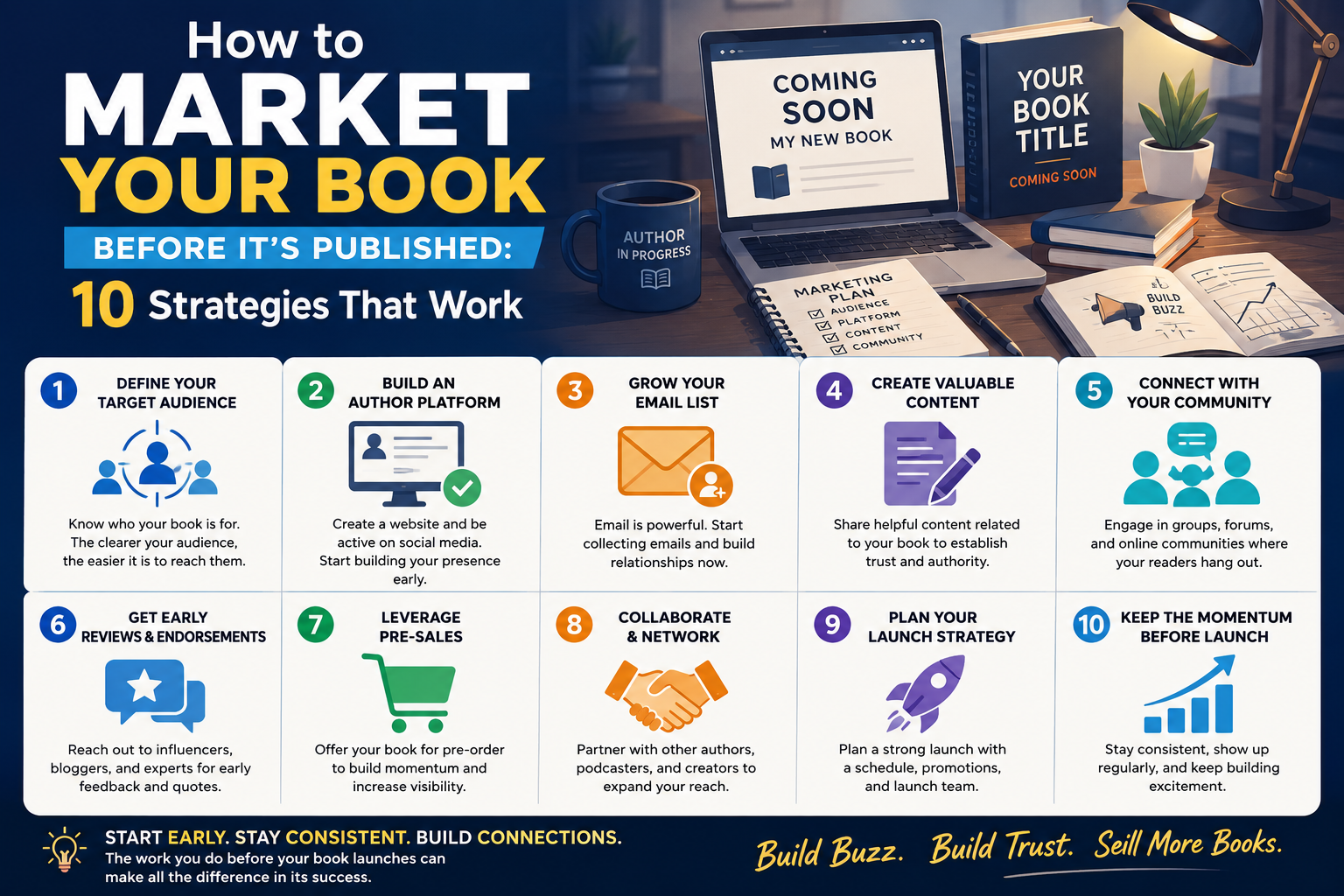
    How to Market Your Book Before It’s Published: 10 Strategies That Work

    Most first-time authors treat book marketing as something that begins on publication day. It doesn’t. By the time your book is published, the most important window for building momentum — the months before launch when your potential audience is being cultivated, your early readers are being recruited, and your visibility is being built — has already passed.

    The most successful book launches in 2026 are not accidents. They are the result of a deliberate pre-launch marketing strategy that starts three to six months before publication day and builds the audience, anticipation, and social proof that turns a launch from a quiet release into a genuine event.

    Here are ten strategies that consistently work — whether you’re a first-time author building from zero or a professional leveraging an existing platform.

    When Should You Start Pre-Launch Marketing? The minimum recommended pre-launch window is 90 days. Six months is better. Twelve months, for a major title tied to a professional brand or business, gives you the most room to build. The earlier you start, the more organic momentum you can generate before launch day — and organic momentum is what drives the review velocity and sales ranking that sustains a book after the initial push.

    Strategy 1: Build Your Author Email List Before Anything Else

    Email list building

    An email list is the single most valuable pre-launch marketing asset you can own — more valuable than social media followers, more reliable than algorithm-driven reach, and more controllable than any platform you don’t own. When your book launches, your email list is the first audience you activate: they buy first, review first, and tell others first. Their early activity drives the algorithmic momentum that carries the book to new readers.

    Start building your list the moment you commit to publishing. Offer a meaningful incentive: a sample chapter, a companion resource, a free guide related to your book’s topic. Your signup page should be live before your cover is designed, before your publishing date is set, and certainly before any other marketing activity begins.

    The goal isn’t a massive list — it’s a list of genuinely interested, engaged readers who are waiting for your book. Even 500 subscribers who actively want your book are worth more than 5,000 who vaguely remember signing up.

    Strategy 2: Create a Pre-Launch Author Website

    Your author website is your central hub — the one place on the internet that you fully control and that anchors every other marketing channel. Before launch, it should include: your book’s title, cover (once available), and a compelling description; an email signup prominently placed; your author bio and credibility indicators; a pre-order or notify-me link as soon as your publication date is set; and a blog or resources section that gives you fresh content to share and a reason for people to return.

    Your website also serves an important SEO function. Publishing regular content about your book’s topic builds organic search visibility over the months before launch, so readers who are searching for exactly what your book covers can find you before it’s even available.

    Strategy 3: Leverage Social Media for Audience Building — Not Just Announcements

    Social media

    The mistake most pre-launch authors make on social media is treating it as a broadcast channel: announcing milestones, posting cover reveals, and counting down to launch day. These things have their place, but they are not how you build an audience.

    You build a social media audience by being genuinely useful and interesting on the topic your book covers, consistently, over time. Share your research. Discuss the ideas in your book. Ask questions that invite conversation. Share your writing and publishing journey authentically. Give value to the people you want to reach — and when your book launches, they’ll feel invested in your success because they’ve been part of the journey.

    Choose one or two platforms where your specific audience actually spends time and go deep there. LinkedIn is non-negotiable for business and professional books. Instagram and TikTok are powerful for narrative non-fiction, memoir, and creative non-fiction. Pinterest drives significant traffic for lifestyle, design, and how-to content.

    Strategy 4: Set Up Pre-Orders

    Pre-orders serve two critical functions. First, they generate cash flow before your book is published. Second — and more importantly — on Amazon, pre-order sales accumulate and count toward your sales rank on launch day, which means a month of pre-order activity can catapult your book into high rankings at the exact moment you need maximum visibility.

    Set up your pre-order on Amazon KDP and IngramSpark as soon as your book’s metadata (title, description, cover) is finalized — even if the interior is still being edited. Promote your pre-order link in every email, on your website, and across all social channels. Offer a meaningful incentive for pre-ordering: bonus content, a signed bookplate, early access to a companion resource, or a personal thank-you.

    Strategy 5: Recruit an ARC (Advance Review Copy) Team

    Review using advanced reader copy

    Reviews are the social proof that turns browsers into buyers — and the time to build your review base is before launch day, not after. An ARC (Advance Review Copy) program involves sending free early copies of your book to a selected group of readers in exchange for honest reviews posted on or around launch day.

    ARC readers can be recruited from your email list, your social media following, relevant online communities in your genre, and book review bloggers and influencers. Send your ARC copies four to eight weeks before your publication date — long enough for readers to finish the book and write their review before launch.

    A book that launches with 20–30 genuine, verified reviews has a dramatically different trajectory than one that launches with zero. Those early reviews provide social proof to new readers, improve your Amazon ranking algorithm, and give you quotable material for your marketing.

    Strategy 6: Pitch Podcasts and Media

    Podcast appearances are one of the most effective pre-launch visibility strategies available to authors in 2026, because they reach concentrated, highly engaged audiences who are already interested in the topic your book covers. A well-chosen podcast with 10,000 listeners in your exact niche is worth more than a generic media mention that reaches a million unqualified readers.

    Start pitching podcasts three to four months before your launch date. You don’t need a published book to be a podcast guest — you need an interesting perspective, a compelling story, and the ability to provide genuine value to the show’s audience. Your book’s impending publication is itself a news hook. Lead with what you can offer the audience; the book mention follows naturally.

    The same logic applies to written media: relevant industry publications, newsletters in your niche, and blogs that serve your target reader. A guest article that showcases your expertise and mentions your upcoming book reaches an audience that was already looking for what you’re writing about.

    Strategy 7: Build Community Around Your Book’s Topic

    Online community

    The most durable author brands are built not just around the author’s name but around the community of people who care about the same things the author writes about. Before your book launches, identify where that community already exists — and start participating genuinely and consistently.

    For business and professional books: LinkedIn groups, industry associations, professional communities, and relevant subreddits. For non-fiction: Facebook groups, online forums, newsletters in your niche. For memoir and narrative non-fiction: literary communities, writing groups, communities organized around the experience or theme your book explores.

    You’re not there to promote your book. You’re there to contribute, help, and be recognized as someone worth paying attention to. The book promotion is what happens organically when people in those communities want to read what you’ve written.

    Strategy 8: Create a Launch Team

    A launch team is a group of committed supporters who agree to help amplify your book on and around launch day. Unlike ARC readers (who are primarily reading for the purpose of reviewing), launch team members are enthusiastic advocates who will share, recommend, and actively promote your book in exchange for exclusive access, early content, and the satisfaction of being part of something.

    Recruit your launch team from your most engaged email subscribers, your closest professional network, and readers who have already expressed enthusiasm about your work. Give them advance content, behind-the-scenes access, and clear, specific actions to take on launch day: post their review, share on social media, recommend to a specific person, mention in a newsletter. The coordinated action of even 30–50 committed launch team members on a single day creates a measurable spike in visibility.

    Strategy 9: Use Content Marketing to Build Pre-Launch SEO

    Content marketing

    Every blog post, article, or video you publish about your book’s topic in the months before launch is building organic search visibility that will continue to work for you long after the launch. A well-optimized piece of content targeting a keyword your potential readers search for can drive traffic to your pre-order page — or to your email list — for months before your book is even available.

    This is especially valuable for professional and non-fiction authors, because your book’s topic almost certainly has search demand from people who need exactly what your book offers. Publishing content that serves that demand early builds your site’s domain authority and ensures you’re visible to the audience that matters most when your book is ready.

    Strategy 10: Engage Your Existing Network With a Personal Touch

    Your personal and professional network is often the most overlooked pre-launch marketing asset — and frequently the most powerful one for generating the early reviews, shares, and word-of-mouth that launch momentum depends on. The people who know you, respect your work, and want you to succeed are your most reliable early advocates.

    Don’t mass-email your entire contact list with a generic announcement. Instead, identify the 50–100 people in your network who are most likely to be genuinely interested in your book and reach out personally — by email, by message, or by phone. Tell them about your book, explain why you think it would be relevant to them specifically, and ask directly: would you be willing to pre-order, leave a review, or share it with one person in your network? Personal outreach converts dramatically better than broadcast, and it costs nothing except time.

    Pre-Launch Marketing Timeline

    Here’s how to sequence these ten strategies across a 90-day pre-launch window:

    TimelineActions to Complete
    6+ months outBegin building email list, set up author website, start social media presence, define target audience clearly
    4–5 months outBegin pitching podcasts and media, start community engagement, draft ARC list, publish first SEO content pieces
    3 months outFinalize cover and book description, set up pre-order, launch ARC program, begin launch team recruitment
    2 months outSend ARCs to reviewers, continue podcast and media outreach, intensify social media content, send pre-order announcements to email list
    1 month outFollow up with ARC readers, brief launch team on day-of actions, schedule social media content, finalize any promotional pricing for launch week
    Launch weekCoordinate launch team activity, send launch-day email, go live on all channels, post reviews and shares, monitor and respond to early activity

    Frequently Asked Questions

    How big does my audience need to be before my book launches?

    There is no minimum. A small, highly engaged audience of people who genuinely want your book will outperform a large, passive audience every time. Focus on quality of engagement over quantity of followers. 200 email subscribers who are excited about your book will drive more launch day reviews and sales than 2,000 social media followers who barely remember why they followed you.

    What if I’m starting from zero — no email list, no social following, no existing platform?

    Then you start building one today. The strategies in this guide all work from zero — they just require more time. This is the strongest argument for starting your pre-launch marketing as early as possible: the earlier you start, the more time you have to build the audience that will make your launch successful. Even three months of consistent effort on email list building and social media content will produce a meaningfully better launch than starting the week before publication.

    How do I find ARC readers if I don’t have an existing audience?

    Several platforms specialize in connecting authors with ARC readers: NetGalley, BookSirens, and Edelweiss are the most widely used. Genre-specific ARC communities also exist on platforms like Facebook, Goodreads, and Reddit. For professional and business books, your professional network — colleagues, clients, peers in your industry — is often the richest source of qualified ARC readers.

    Should I spend money on pre-launch advertising?

    Pre-launch paid advertising can be effective, but only once your landing page or pre-order link converts well organically. Driving paid traffic to a weak landing page wastes budget. Focus first on optimizing your pre-order or email signup page, then consider paid promotion in the final 30 days before launch to amplify what’s already working. Email list building ads on Meta (Facebook and Instagram) can be particularly cost-effective for audience building well in advance of launch.

    How does Bookpress Publications support the pre-launch marketing process?

    Bookpress Publications offers comprehensive book marketing services that include pre-launch strategy development, ARC program management, author website setup, content planning, and launch campaign coordination. Rather than figuring out the marketing alongside the editing and publishing process, our authors work with a dedicated marketing team that integrates their launch strategy with their publication timeline from day one. Book a free consultation to discuss how we can support your specific launch.

    Your Launch Day Starts Today

    The single most common regret among self-published authors is not starting their marketing earlier. The book was edited, the cover was beautiful, the formatting was professional — but the marketing was left for after publication, which meant the launch day arrived with no audience to receive it.

    The ten strategies in this guide are not complicated. They don’t require a large budget, a dedicated marketing team, or years of experience. They require consistency, genuine investment in building relationships with your future readers, and the willingness to start before you feel ready.

    Bookpress Publications’ book marketing team helps authors build pre-launch audiences and execute launches that generate real results. Book a free consultation to discuss your book’s marketing strategy and find out how our team can support your journey from manuscript to bestselling author.

  • Book Editing Services Explained: Developmental, Copy, and Proofreading Differences

    Book Editing Services Explained: Developmental, Copy, and Proofreading Differences

    “My manuscript just needs a quick proofread.” This is one of the most common things first-time authors say before working with a professional editor — and it’s almost never true. Not because authors are wrong about their writing, but because most authors don’t yet have a clear picture of what professional book editing actually involves, how many distinct stages it encompasses, or what each one does for a manuscript.

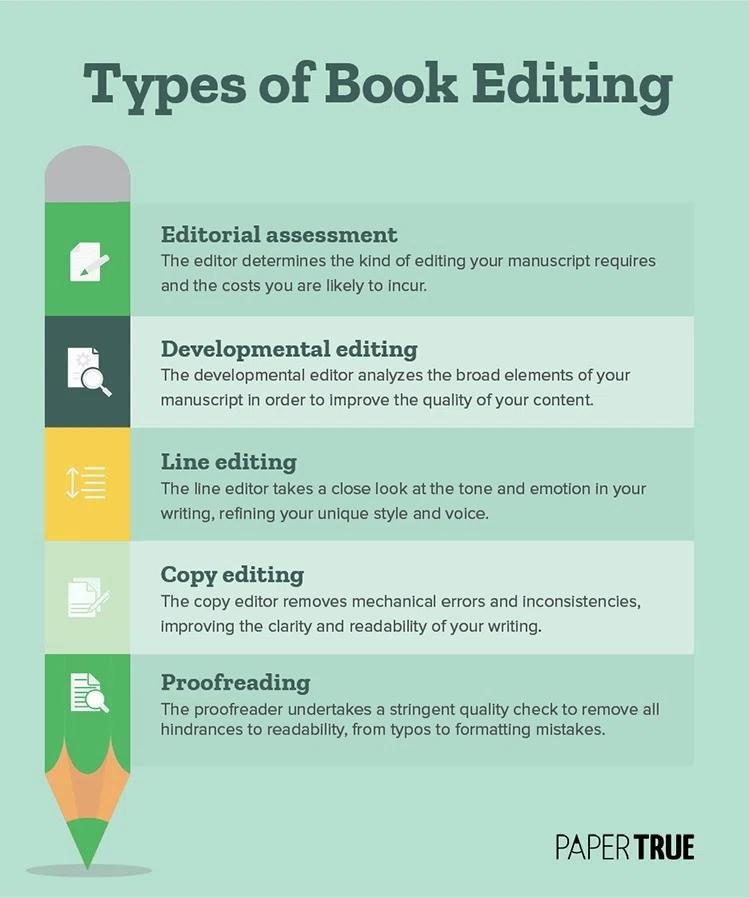
    Professional book editing is not one thing. It is four distinct types of editorial work, each addressing a different dimension of quality, applied in a specific sequence. Understanding the difference between developmental editing, copy editing, proofreading, and beta reading — and knowing which ones your manuscript needs — is the foundation of a successful publishing process.

    This guide explains all four clearly, tells you when each applies, and gives you a practical framework for deciding what your specific manuscript needs.

    The Core Principle Every layer of editing addresses a different set of questions. Developmental editing asks: Does this book work? Copy editing asks: Does this writing work? Proofreading asks: Is this text clean? Beta reading asks: Does this land with a real reader? Each is essential. None substitutes for the others.

    The Four Types of Book Editing

    Book editing

    Let’s explore the various types of book editing that you might come across.

    1. Developmental Editing

    Developmental editing — sometimes called structural editing or substantive editing — is the highest-level, most comprehensive form of editorial feedback. A developmental editor reads your entire manuscript and evaluates it as a whole, focusing on the big questions:

    • Does the book’s central argument or premise hold together from beginning to end?
    • Is the structure logical? Are chapters in the right order? Does the book build effectively toward its conclusion?
    • Are there gaps in the argument — sections where a reader will be confused, unconvinced, or left without the information they need?
    • Is the pacing right? Are some sections too dense, others too thin?
    • Does each chapter serve a clear purpose, and does it deliver on that purpose?
    • Is the opening compelling enough to hold a reader’s attention? Does the ending satisfy?

    A developmental editor will typically deliver a detailed editorial letter (often 5–15 pages) outlining their findings, along with inline comments throughout the manuscript. They are not correcting sentences — they are assessing and improving the architecture of the book.

    When do you need developmental editing?

    If you’ve written a complete first or second draft and you’re not certain whether it’s working — whether the structure is sound, whether the argument is compelling, whether the pacing holds — you need a developmental edit. This is especially important for first-time authors, for complex nonfiction with multi-layered arguments, and for any book where the overall conceptual framework is central to its value.

    Developmental editing is also the right choice if you’ve received feedback from beta readers or early readers that something “isn’t quite working” but you can’t identify what. A developmental editor will find it.

    When can you skip developmental editing?

    For simple, tightly scoped manuscripts — a short practical guide with a clear structure, a straightforward memoir with a linear timeline — a developmental edit may be unnecessary if you’ve already received substantive feedback on the structure and are confident it’s sound. But for most authors, especially first-time authors, skipping developmental editing is a risk. The cost of discovering structural problems after the book is published is far higher than the cost of fixing them before.

    2. Copy Editing

    Copy editing operates at the sentence and paragraph level. Where a developmental editor asks “does this book work?”, a copy editor asks “does this writing work?” These are fundamentally different questions — and a manuscript that has passed developmental editing can still have significant copy editing needs.

    A copy editor addresses:

    • Clarity — Are sentences clear and easy to understand? Are there ambiguous phrasings that could confuse a reader?
    • Consistency — Are character names, terminology, dates, and facts consistent throughout the manuscript?
    • Style and voice — Is the writing consistent in tone throughout? Does the author’s voice remain stable, or does it shift in ways that feel jarring?
    • Grammar and usage — Are there grammatical errors, awkward constructions, or usage issues that undermine the prose?
    • Sentence variety and rhythm — Is the prose monotonous, or does it have the rhythm and variety that makes reading pleasurable?
    • Word choice — Are words chosen precisely? Are there places where a different word would be more accurate, more vivid, or more appropriate?

    Copy editing is typically delivered as a tracked-changes document, with queries and comments from the editor where decisions are needed from the author.

    When do you need copy editing?

    Every manuscript that will be published for a general audience needs copy editing. Full stop. This applies whether you’re a strong writer or a first-time author, whether your manuscript has already been through developmental editing or not. The reason is simple: no author can see their own manuscript with the detached, precise eye of a professional editor who is reading it for the first time. You know what you meant to say; a copy editor reads what you actually said.

    Copy editing is non-negotiable if you want your book to be taken seriously by readers. The absence of professional copy editing is immediately apparent to experienced readers and is one of the most common reasons for negative reviews of self-published books.

    3. Proofreading

    Proofreading is the final editorial stage before a manuscript is sent to layout or uploaded for publication. It is not the same as copy editing — and cannot substitute for it.

    A proofreader reads the nearly-final manuscript (or, ideally, the formatted page proofs) with one specific purpose: to catch anything that slipped through copy editing. This includes:

    • Typos and spelling errors that were missed or introduced during copy editing revisions
    • Punctuation inconsistencies
    • Formatting irregularities — inconsistent spacing, stray characters, incorrect font changes
    • Headers and chapter titles that don’t match the table of contents
    • Captions, footnotes, or endnotes that contain errors
    • Any factual inconsistencies in proper names, dates, or figures

    Proofreading is typically done on the formatted, near-print-ready document — so errors in layout (widows, orphans, incorrect hyphenation) can also be caught at this stage.

    When do you need proofreading?

    Always — for any book that will be published. Proofreading is the last line of defence before your book reaches readers. Even if your copy editor was excellent and thorough, errors slip through. New errors can be introduced during author revisions. The formatting process itself can introduce inconsistencies. Proofreading is the safety net that catches all of this.

    4. Beta Reading

    Beta reading is a distinct form of feedback that sits alongside the professional editing process rather than within it. A beta reader is typically not a professional editor — they are a representative member of your target audience who reads your manuscript and provides feedback from a reader’s perspective.

    Beta readers respond to questions like:

    • Was there a point where you felt the book lost you or your interest flagged?
    • Were there sections you found confusing, unconvincing, or unclear?
    • Did the opening compel you to keep reading?
    • Was the conclusion satisfying?
    • What was the most valuable part of the book for you?
    • Is there anything you expected the book to cover that it didn’t?

    Beta reading is particularly valuable for fiction and narrative non-fiction, where the reader experience — pace, tension, emotional resonance — is central to the book’s success. It is also valuable for any book where the author is uncertain whether the intended audience will respond as hoped.

    When should you use beta readers?

    Ideally, after a developmental edit and before copy editing. At this stage, the structure is sound, but there’s still time to make meaningful changes based on reader feedback. Beta reading after copy editing is less useful because significant revisions post-copy-edit create additional editing work.

    Editing at a Glance: How the Four Types Compare

     Developmental EditCopy EditProofreadingBeta Reading
    Primary FocusBig-picture structure & argumentSentence-level clarity & styleFinal errors & typosReader experience & comprehension
    When in ProcessAfter first complete draftAfter developmental editAfter copy editCan occur at any draft stage
    What It ChangesStructure, chapters, sections, pacingSentences, paragraphs, word choiceTypos, punctuation, consistencyPerspective on what’s unclear or missing
    Who Does ItSpecialist developmental editorExperienced copy editorProfessional proofreaderTrusted readers or paid beta readers
    Typical Cost (60K words)$3,500–$7,000$2,000–$5,000$900–$2,000$200–$800 or free
    Essential?Highly recommendedYes — non-negotiableYes — non-negotiableValuable but optional

    The Right Editing Sequence for Your Manuscript

    Beta readers

    If your manuscript needs all four types of editing, the correct sequence is:

    1. Beta reading (optional, but valuable — get reader perspective while the manuscript is still flexible)
    2. Developmental editing — assess and fix the architecture before line-level work begins
    3. Author revisions — implement changes from the developmental edit
    4. Copy editing — sentence and paragraph level refinement of the revised manuscript
    5. Author review — respond to copy editor’s queries and approve changes
    6. Layout / formatting — design and format the final manuscript
    7. Proofreading — final quality check on the formatted, near-print-ready document

    This sequence matters. Doing copy editing before developmental editing is one of the most common (and expensive) mistakes authors make — because if the developmental edit recommends significant structural changes, the copy-edited sections may need to be substantially rewritten, wasting the copy editing investment.

    What Bookpress Publications Recommends For most first-time authors and professional authors, we recommend at minimum: developmental editing (or a detailed structural assessment), copy editing, and proofreading. For complex manuscripts, research-heavy non-fiction, or books that are central to your professional brand, invest in all stages. The quality difference between a book that has been through full professional editing and one that hasn’t is immediately apparent to readers — and the investment is recoverable many times over through sales, reputation, and opportunity.

    Frequently Asked Questions

    Can I skip developmental editing if I’ve already had friends or colleagues read my manuscript?

    Feedback from people who know you — or who aren’t professional editors — is valuable, but it is not a substitute for developmental editing. Friends and colleagues tend to be encouraging, tend not to flag structural problems clearly, and don’t have the editorial framework to identify and articulate what specifically isn’t working. A professional developmental editor brings a trained, objective eye that non-professionals simply can’t replicate.

    How do I find a good book editor?

    Look for editors who specialize in your genre or category, have verifiable experience with published books, can provide references or testimonials from previous authors, and whose editorial style feels like a good fit based on a sample edit. Professional associations like the Editorial Freelancers Association (EFA) and the American Copy Editors Society (ACES) maintain directories of qualified editors. At Bookpress Publications, our editorial team is matched to each project based on genre expertise and manuscript needs.

    Can the same editor do both developmental editing and copy editing?

    Some editors are skilled at both, but many specialize in one or the other. Developmental editing requires a high-level, structural perspective; copy editing requires meticulous line-by-line attention. Using the same editor for both is possible but can be less effective than using specialists for each stage, because the perspectives required are genuinely different. A full-service publisher like Bookpress coordinates the right editorial expertise for each stage.

    How many rounds of editing does a typical book need?

    Most manuscripts go through one round of developmental editing (with one round of author revisions), followed by one round of copy editing (with author review), followed by one proofread. Particularly complex manuscripts, or those with significant structural issues identified in developmental editing, may require a second structural pass before moving to copy editing. Additional rounds add time and cost but are sometimes necessary to reach the quality standard the book deserves.

    What’s the difference between a line edit and a copy edit?

    These terms are often used interchangeably, but technically a line edit focuses on style, voice, and the overall quality of the prose at a sentence level — it is more creative and interpretive than copy editing. Copy editing is more technical, focusing on grammar, consistency, fact-checking, and adherence to a style guide. Many professional editors offer “copy editing with a line edit focus,” which combines both. Ask your editor what their process includes before engagement.

    Your Manuscript Deserves Every Stage

    The difference between a book that earns five-star reviews, drives business outcomes, and stands the test of time — and one that gets quietly returned and forgotten — is almost always editorial. Not because the ideas were different, but because one was professionally edited and one wasn’t.

    Understanding the four types of editing and what each one does is the first step toward making the right investment in your book. The second step is working with a team that brings genuine expertise to each stage.

    Bookpress Publications offers professional book editing services at every stage — developmental, copy editing, and proofreading — delivered by experienced editors matched to your genre and manuscript. Book a free consultation to discuss your manuscript’s editing needs and get a clear, itemized picture of what the process involves for your specific project.

  • Why Every Business Executive Should Write a Book in 2026

    Why Every Business Executive Should Write a Book in 2026

    There are thousands of ways to build your professional reputation. A strong LinkedIn profile. Speaking at industry conferences. Being quoted in the right publications. Building a track record of results. All of these work — but there is one that works at a categorically different level from the rest.

    Writing a book. Not because it’s on your bucket list. Not because you want to call yourself an author. But because in 2026, a published book is the single most powerful credibility asset a business executive can own — and most of your competitors haven’t written one.

    This isn’t a romantic notion about the timeless power of the written word. It’s a practical argument grounded in how authority is built, how clients are won, how careers advance, and how legacies are established. Let’s make the case.

    The Authority Problem Every Executive Faces

    Writing or rather typing a manuscript

    You’ve spent years — maybe decades — developing your expertise. You’ve navigated complex business environments, made hard calls, built teams, served clients, and learned things that most people in your field simply don’t know. That expertise is genuinely valuable. It could help thousands of people if it were more accessible.

    But how do you communicate that depth of expertise to someone who has never met you? A LinkedIn profile shows your career history. A website lists your services. A conference talk reaches people who were already in the room. None of these create the sustained, deep impression that a well-written book creates.

    A book is a 60,000-word demonstration of everything you know, how you think, and why your perspective is worth trusting. A prospect who reads your book doesn’t just know your credentials — they know your mind. That’s a fundamentally different kind of trust.

    Eight Compelling Reasons to Write Your Book in 2026

    Why you should write a book

    Let’s take a look at eight of the most common reasons you should write a book this year.

    1. It Establishes You as the Definitive Expert in Your Field

    There’s a reason we call credible experts “authorities” — and a reason the word shares a root with “author.” In almost every professional field, the people who are most widely recognized as experts have written books. Not because writing a book makes you an expert, but because it proves you are one.

    A published book signals that your ideas are substantive enough to fill hundreds of pages, that you’ve thought deeply enough about your field to synthesize it for others, and that you’re willing to stand behind your perspective publicly. For clients, partners, and employers evaluating who to trust, this signal is enormously powerful.

    2. It Generates Inbound Leads Automatically

    Most business development is outbound — you reach out to prospects, you follow up, you attend events, you work your network. A book flips this equation. When someone searches for solutions to the problem your book addresses, reads it, and reaches out because they want to work with the person who wrote it, that’s inbound business development that requires none of your time.

    Executives who have published books consistently report that the inbound quality improves dramatically. Prospects who found them through their book are already pre-sold on their expertise. The sales conversation starts from a position of established trust rather than from scratch.

    3. It Opens Doors That Nothing Else Does

    Conference speaking invitations. Media interview requests. Podcast appearances. Advisory board positions. Board directorships. Partnership conversations with organizations that would otherwise be difficult to reach. All of these opportunities are dramatically more accessible with a published book on your credentials.

    This isn’t anecdotal. Event organizers, journalists, and podcast hosts actively look for published experts because a book validates that someone has a coherent, developed perspective worth sharing with an audience. The book is both the credential and the content brief.

    4. It Differentiates You in a Crowded Market

    In almost any professional field, the top tier of practitioners is crowded with competent, experienced people. The differentiators that move clients from “considering” to “choosing” are often intangible — who do I trust more? Who seems to understand my situation more deeply? Who feels like the right fit?

    A book creates differentiation that is both tangible and lasting. Your competitors may have similar experience, similar case studies, and similar client lists. But if you’ve written the definitive book on your approach to the problem, you own a position in the market that they can’t simply replicate.

    5. It Creates a Scalable Version of Your Expertise

    Your time is finite. There are only so many clients you can serve, so many talks you can give, so many one-to-one conversations you can have. A book allows your expertise to scale beyond the hours in your day. It teaches what you teach, argues what you argue, and positions you exactly as you want to be positioned — to an unlimited number of readers, in perpetuity.

    For executives building consulting practices, advisory businesses, or thought leadership platforms, this scalability is one of the most compelling practical arguments for writing a book.

    6. It Strengthens Your Pricing Power

    Clients pay more for experts than for generalists. They pay more for the person everyone in their network recommends than for the person they found on a search results page. And they pay significantly more for the person who wrote the book on the topic than for someone who hasn’t.

    A published book is one of the most effective ways to move your market positioning from “vendor” to “authority” — and that shift has a direct and measurable impact on what you can charge for your time and expertise.

    7. It Creates a Legacy That Outlasts Any Single Role or Company

    Careers change. Companies change. Industries change. A book you write in 2026 will still be read in 2031 — and in 2036. It will be the thing people reference when they talk about your contribution to your field. It will be the artifact that your team, your clients, your mentees, and your successors will point to.

    For executives thinking seriously about their professional legacy — not just their next deal — a book is one of the very few tools that creates lasting, compounding impact.

    8. It Forces You to Clarify Your Thinking

    This benefit is the one most executives don’t expect until they’re in the process: writing a book forces you to articulate ideas you’ve carried in your head for years with a precision and coherence that no other medium demands. The process of organizing your expertise into a structure that will make sense to a reader who doesn’t already share your context is one of the most intellectually rigorous things you can do.

    Many executives report that the process of writing their book gave them a clearer, more compelling way to explain their methodology, their philosophy, and their value — not just to readers, but to clients, to their team, and to themselves.

    The Most Common Objections — And Why They Don’t Hold Up

    The ObjectionThe Reality
    “I don’t have time to write a book.”This is the most common objection and the most solvable. Professional ghostwriting exists precisely for this situation. Your ideas, your voice, your story — written by a professional who handles the time investment. Most executives who have published books with ghostwriting help report the process required less time than they expected.
    “I’m not a natural writer.”Books are not won or lost on the quality of the author’s natural prose. They’re won or lost on the quality of the ideas, the clarity of the framework, and the relevance of the content to the reader. Professional editing and ghostwriting ensure the quality of the writing — your job is the expertise.
    “Nobody will care about my book.”This is a market positioning question, not a writing question. The right book — one that addresses a real problem your target audience faces, written with genuine expertise, and marketed to the right channels — reaches exactly the readers who will care about it. Niche beats broad every time.
    “I don’t know where to start.”This is exactly what a professional full-stack publishing team handles. From structuring your idea to ghostwriting, editing, designing, publishing, and marketing — every step is manageable when you have the right support. You don’t need to know the publishing industry; you need the right publishing partner.

    What Kind of Book Should You Write?

    Common types of books

    The most effective business books for executives fall into three broad categories, and the right one depends on your goals and expertise:

    The Methodology Book

    This is the most common and often most commercially successful type of business book. You have a proven approach, framework, or system that delivers results in your field — and you write the book that explains it. The methodology book establishes you as the inventor or champion of a particular approach, making you the natural choice when clients want that approach applied to their problem.

    The Expertise Book

    This is a deep dive into a specific topic where your knowledge is genuinely authoritative. Less framework-driven than a methodology book, this type positions you as the definitive source on a particular subject — ideal for executives in specialized fields where deep domain knowledge is the primary credential.

    The Vision / Leadership Book

    This type makes a strong argument about the future of an industry, a discipline, or a way of working. It is less about your personal methodology and more about your perspective on where your field is heading and why that matters. Vision books are powerful for executives who want to lead the conversation in their industry rather than just participate in it.

    You Don’t Have to Write It Alone The single biggest shift in executive book publishing over the past decade is the normalization of professional ghostwriting and full-service publishing support. Today’s most successful business books are almost never written in isolation. They are collaborations between executives with valuable expertise and professional publishing teams with the craft skills to bring that expertise to the page at the highest possible standard.

    Frequently Asked Questions

    How long does it take to produce a business book?

    With professional ghostwriting and a dedicated publishing team, a typical business book — 40,000 to 65,000 words — takes six to nine months from initial concept to published book. This includes the ghostwriting phase, all editing stages, design, formatting, and launch preparation. For executives working with a full-stack publisher like Bookpress, the process is structured and managed from start to finish, so your time commitment is focused on interviews and approvals rather than project management.

    Will having my name on a ghostwritten book damage my credibility?

    No. Ghostwriting is a standard, widely accepted practice in business publishing. The ideas, the expertise, the framework, and the authority behind the book are entirely yours — the ghostwriter is a craft professional who helps you express them. No reader, client, or professional contact will think less of your book because of how it was written. What they will respond to is the quality of the ideas and the credibility they convey.

    What is the best way to market a business book?

    The most effective channels for business book marketing depend on where your audience is. LinkedIn is essential for most executives. A targeted launch email campaign to your existing network drives early reviews and sales velocity. Podcast interviews — especially in your niche — reach qualified audiences. Amazon advertising provides ongoing discoverability. And speaking engagements both promote the book and are generated by it. A full-stack publishing team like Bookpress can build and manage your launch and ongoing marketing strategy.

    Should I self-publish or try to get a traditional publishing deal?

    For most executives, self-publishing (with professional support) is the better strategic choice. It is faster, gives you full creative control, results in higher royalties, and allows you to publish to your own timeline rather than a publisher’s. Traditional publishing offers prestige and bookstore distribution, but the acquisition process can take years and requires a literary agent. Unless securing a Big Five deal is a specific strategic goal, most executives are better served by a high-quality self-publishing approach.

    How do I know if my ideas are compelling enough for a book?

    If you have a framework, perspective, or body of expertise that consistently makes clients, colleagues, or audiences say “I’ve never heard anyone explain it that way” — you have a book. The bar is not that your ideas are unlike anything ever written; it’s that they are valuable, clearly articulated, and genuinely useful to the audience you’re trying to serve. A conversation with a professional publishing consultant can help you validate your concept and identify the angle that will resonate most strongly in the current market.

    Your Book Is Waiting to Be Written

    In 2026, the executives who are building the strongest brands, commanding the highest fees, and leading the most important conversations in their industries are the ones who have committed to communicating their expertise at the highest level. A book is not the only way to do that — but it is the one that works the longest, reaches the furthest, and earns the deepest trust.

    The expertise is already inside you. The story already exists. The framework you’ve refined over years of practice is genuinely valuable and genuinely publishable. What most executives are missing is not the material — it’s the team to bring it to life.

    Bookpress Publications specializes in helping business executives write, publish, and market books that build authority and drive business results. Book a free consultation today to discuss your book concept, explore whether ghostwriting is the right fit, and get a clear picture of the publishing process from concept to launch.

  • The Real Cost of Publishing a Book in the USA (2026 Breakdown)

    The Real Cost of Publishing a Book in the USA (2026 Breakdown)

    Before you commit to publishing your book, you want to know one thing: what is this going to cost me? It’s a completely reasonable question — and one that the publishing industry has historically been terrible at answering clearly. Vague phrases like “it depends” and “packages start from” are everywhere. Actual numbers are hard to find.

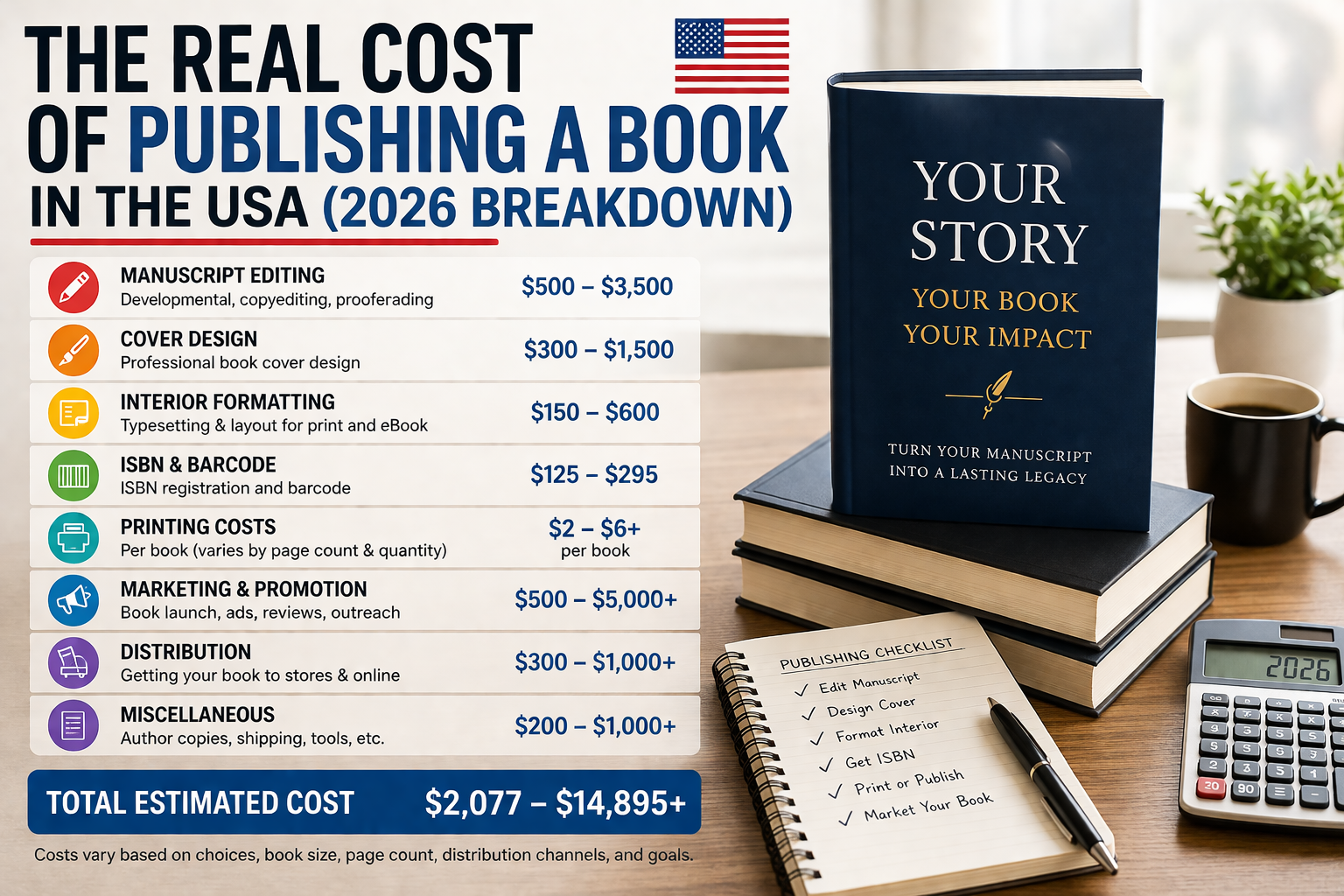
    This guide cuts through that. We’re going to give you real cost ranges for every stage of the book publishing process in the United States in 2026 — from manuscript editing to cover design, formatting, distribution, and marketing — so you can plan your budget with confidence and make informed decisions about where to invest and where cutting corners will cost you far more than it saves.

    How to Use This Guide The ranges below reflect what you can realistically expect to pay for professional-quality services in the US market in 2026. “Budget” means serviceable but limited. “Mid-range” represents the sweet spot most authors should aim for. “Premium” reflects top-tier talent or full-service agency pricing. We’ll flag which stages are worth the premium and which are fine at mid-range.

    The Six Cost Categories of Publishing a Book

    Publishing a book involves six distinct cost areas. Some are essential and non-negotiable; others depend on your goals, genre, and distribution strategy. We’ll cover each in order of when it typically appears in the publishing process.

    1. Editing

    Book editing

    Editing is the single most important investment you can make in your book — and the one most authors either underestimate or try to skip. A professionally edited book is not a nicety; it is the baseline standard readers expect. Poor editing is the most common reason for negative reviews and a book’s failure to gain traction.

    There are three distinct editing stages, each serving a different purpose:

    Developmental Editing

    Developmental editing is the big-picture pass. Your editor evaluates the overall architecture of the book: Does the argument hold together? Is the narrative compelling from beginning to end? Are chapters in the right order? Does the pacing work? Are there gaps, redundancies, or sections that undermine the book’s core promise?

    This is the most intellectually demanding form of editing and typically the most expensive. It is also the most valuable — catching structural problems before copyediting and design saves enormous time and money downstream.

    Copy Editing

    Copy editing works at the sentence and paragraph level: clarity of expression, word choice, grammar, consistency, style, and flow. A good copy editor doesn’t just fix errors — they elevate your prose and ensure your voice comes through cleanly and consistently throughout the manuscript.

    Proofreading

    Proofreading is the final pass before the manuscript goes to layout. It catches residual typos, punctuation errors, and formatting inconsistencies. It is not a substitute for copy editing — it is the last quality check before the book is locked for production.

    ServiceBudget RangeMid-RangePremium
    Developmental Edit$1,500–$3,500$3,500–$7,000$7,000–$15,000+
    Copy Editing$800–$2,000$2,000–$5,000$5,000–$10,000
    Proofreading$400–$900$900–$2,000$2,000–$4,000
    All Three Stages (bundled)$2,500–$5,000$5,000–$12,000$12,000–$25,000+

    Rates vary by manuscript length and genre. Figures above are based on a standard 60,000–80,000 word manuscript. Children’s books and shorter non-fiction cost considerably less; research-heavy manuscripts can cost more.

    Worth the premium? Yes, for developmental editing — especially if this is your first book or your manuscript is complex. Copy editing and proofreading are well-served at mid-range with an experienced professional.

    2. Cover Design

    Various book covers

    Your cover is your book’s most powerful marketing asset. It communicates genre, quality, and tone in under a second — and readers absolutely make purchasing decisions based on it. Cover design pricing varies enormously based on the designer’s experience, the complexity of the design, whether it requires custom illustration, and whether you need both a print cover (with spine and back) and an ebook version.

    ServiceBudget RangeMid-RangePremium
    Ebook Cover Only$200–$500$500–$1,200$1,200–$3,000
    Print + Ebook Cover$400–$900$900–$2,500$2,500–$6,000+
    Cover with Custom Illustration$800–$2,000$2,000–$5,000$5,000–$15,000+
    Full Cover + Interior Branding$1,200–$3,000$3,000–$7,000$7,000–$20,000

    Worth the premium? For most authors, mid-range cover design from a specialist in your genre is the right investment. Premium matters most for children’s books with full custom illustration, high-profile professional books, and any book where visual branding extends across a series or author platform.

    3. Interior Formatting and Layout

    Inner page formatting

    Interior formatting transforms your edited Word document into a properly laid-out book — with professional typography, correct margins and gutters, consistent chapter headers, and proper treatment of all front and back matter. For print books, this includes preparing the print-ready PDF at your specific trim size. For ebooks, it means creating a clean, reflowable ePub or MOBI file.

    ServiceBudget RangeMid-RangePremium
    Ebook Formatting Only$100–$300$300–$700$700–$1,500
    Print Interior Formatting$200–$600$600–$1,500$1,500–$3,500
    Print + Ebook (both formats)$350–$900$900–$2,000$2,000–$4,500
    Complex layout (tables, diagrams, etc.)$600–$1,500$1,500–$3,500$3,500–$7,000+

    Worth the premium? Most standard non-fiction and narrative books are well-served at mid-range. Premium is justified for books with complex layouts: heavily illustrated works, textbooks, cookbooks, how-to guides with frequent diagrams, and coffee-table books.

    4. ISBN, Copyright, and Publishing Setup

    Book publishing

    These are the administrative costs of putting your book into the publishing ecosystem. They are relatively modest but essential.

    ItemTypical Cost in 2026
    Single ISBN (Bowker, USA)$125
    Block of 10 ISBNs$295
    Block of 100 ISBNs$575
    US Copyright Registration$35–$65 (online filing)
    KDP Publishing SetupFree
    IngramSpark Setup Fee$49 per title (print + ebook)
    IngramSpark Title Revision Fee$25 per revision
    LCCN (Library of Congress)Free (application required)

    Note: Amazon KDP and IngramSpark offer free ISBNs, but these list the platform as your publisher of record. For authors building a serious publishing imprint or professional author brand, purchasing your own ISBNs through Bowker is the right move.

    5. Marketing and Launch

    Book release and marketing

    Book marketing is the most variable cost category — the range between doing almost nothing and running a full professional campaign is enormous. Here is a realistic breakdown of the most common marketing investments:

    ServiceBudget RangeMid-RangePremium
    Author Website (design + setup)$300–$800$800–$3,000$3,000–$8,000+
    Amazon Advertising (monthly)$100–$300/mo$300–$800/mo$800–$3,000+/mo
    Book Launch PR Campaign$1,500–$4,000$4,000–$10,000$10,000–$30,000+
    Book Marketing Consultant (project)$1,000–$3,000$3,000–$8,000$8,000–$25,000+
    NetGalley / ARC Distribution$450–$700/listingN/AN/A
    Social Media Advertising (monthly)$200–$500/mo$500–$2,000/mo$2,000–$8,000+/mo

    The most important marketing truth: marketing is not optional if you want your book to reach readers. Even the best book in the world needs to be found. For authors publishing to build a professional brand or generate business leads, a proper launch investment typically delivers substantial ROI — a well-marketed book can drive inbound inquiries and speaking opportunities for years.

    6. Ghostwriting (If Applicable)

    Ghostwriting in book publishing

    If you’re working with a professional ghostwriter to produce your manuscript, this is typically the largest single cost in the publishing process. Professional rates reflect the skill, time, and research required to produce a book-length work that genuinely captures your voice and expertise.

    ServiceBudget RangeMid-RangePremium
    Short Business Book (30K–40K words)$15,000–$25,000$25,000–$45,000$45,000–$80,000+
    Standard Non-Fiction (50K–65K words)$20,000–$35,000$35,000–$65,000$65,000–$120,000+
    Memoir / Expert Book (65K–85K words)$30,000–$50,000$50,000–$90,000$90,000–$150,000+

    These figures reflect experienced US-based ghostwriters. Rates on offshore platforms are lower, but quality, voice capture, and reliability vary significantly. For a book attached to your professional brand, the quality of the ghostwriting directly impacts the quality of the book — and what it communicates about you.

    Total Budget Ranges by Author Profile

    Putting it all together, here are realistic total budget ranges for three common author profiles:

    Author ProfileWhat’s IncludedRealistic Total Budget
    First-time author, self-publishing non-fiction (no ghostwriting)Copy edit + proofread, mid-range cover, basic formatting, KDP setup, minimal marketing$3,500–$8,000
    Professional / executive author with ghostwritingGhostwriting, full editing stack, premium cover, print + ebook formatting, IngramSpark, launch marketing$40,000–$90,000+
    Business author, self-written, full-service publishingFull editing stack, premium cover, formatting, ISBN, launch campaign, ongoing Amazon ads$12,000–$30,000
    The Investment Perspective A professionally published book attached to a business or professional brand is not purely a cost — it is an asset. Authors report speaking fee increases, inbound client inquiries, media opportunities, and partnership conversations that were directly traceable to their book. A well-published book typically returns its investment many times over.

    Where First-Time Authors Overspend and Underspend

    Here are some of the most common overspend and underspend factors for authors.

    Common overspends

    • Paying for premium distribution services that offer no advantage over direct KDP and IngramSpark setup
    • Purchasing large quantities of author copies before the book has been validated with readers
    • Investing in expensive PR campaigns before building a baseline of reviews and sales momentum

    Costly underspends

    • Skipping developmental editing and discovering structural problems after the book is published
    • Using a DIY or budget cover that signals amateur quality and suppresses sales from day one
    • Underinvesting in launch marketing and expecting organic discovery to do the work — it rarely does

    Frequently Asked Questions

    Can I publish a book for under $1,000?

    Technically, yes — but not at a standard that competes in the current market. At under $1,000 you’re typically choosing between professional editing and a professional cover, not funding both. You can use free KDP ISBNs, DIY formatting with a template, and publish without marketing spend. The result will likely be a book that doesn’t generate significant sales or build your reputation meaningfully. For a book attached to your professional brand, this is a false economy.

    Are there hidden costs in book publishing I should know about?

    The most common surprises are: IngramSpark’s per-revision fees (which add up if your manuscript isn’t locked before upload), the cost of author copies for review purposes, ongoing Amazon advertising spend that many authors don’t budget for, and website hosting and maintenance. Always ask your publishing partner to walk through the full cost picture including post-publication expenses before you start.

    Does traditional publishing cost the author anything?

    No — in traditional publishing, the publisher funds editing, design, formatting, and distribution. The trade-off is that you receive an advance (often modest for debut authors) and royalties of 10–15% of cover price, versus 35–70% for self-published authors. Traditional publishing also involves a lengthy acquisition process, often taking 1–3 years from manuscript to bookstore. Most professionals who want to publish within a reasonable timeframe and retain creative control choose self-publishing or a hybrid model.

    What is hybrid publishing and how does it affect costs?

    Hybrid publishing sits between traditional and self-publishing: a hybrid publisher provides professional services (like a traditional publisher) but the author pays for those services (like self-publishing). The author retains higher royalties and more creative control than in traditional publishing, but invests upfront. Quality among hybrid publishers varies enormously — always ask to see their published books and check their distribution reach before signing a contract.

    Can Bookpress Publications give me a customized cost estimate?

    Yes — absolutely. Every project is different, and cookie-cutter pricing rarely reflects the actual scope of what your book needs. Bookpress offers a free initial consultation where we review your manuscript, your publishing goals, and your timeline, and provide a clear, itemized estimate for each stage of the process. No vague packages — just transparent pricing for exactly what your project requires.

    Budget With Confidence. Publish With Purpose.

    The cost of publishing a book is real — and for a professionally produced book that builds your brand, it is a meaningful investment. But it is not an opaque or unknowable one. Every stage has a market rate, every rate reflects a quality level, and every quality level has consequences for how your book performs and what it communicates about you.

    The authors who get the best returns on their publishing investment are the ones who go in with clear expectations, invest in the stages that matter most, and work with a team that has done this before.

    Ready to get a real, itemized estimate for your book? Book a free consultation with Bookpress Publications and we’ll walk through your specific project — manuscript length, genre, timeline, and goals — and give you an honest, detailed picture of what it will take to publish your book to a professional standard.

  • Book Ghostwriting Services: What to Expect and How It Works

    Book Ghostwriting Services: What to Expect and How It Works

    You have a story worth telling. Or an expertise that the world needs. Or a career’s worth of hard-won lessons that could genuinely change someone’s life or business. But when you sit down to write, the blank page stares back — or life simply doesn’t give you the hours required to do the manuscript justice.

    That’s exactly what professional book ghostwriting services are for. And if you’re feeling uncertain about whether ghostwriting is ‘legitimate,’ or wondering whether hiring someone to write your book means it isn’t really yours — you’re not alone. These are the first questions almost every client asks. This guide is going to answer them honestly, and then walk you through exactly what the ghostwriting process looks like from first conversation to finished manuscript.

    What Is Book Ghostwriting?

    Ghostwriting gag

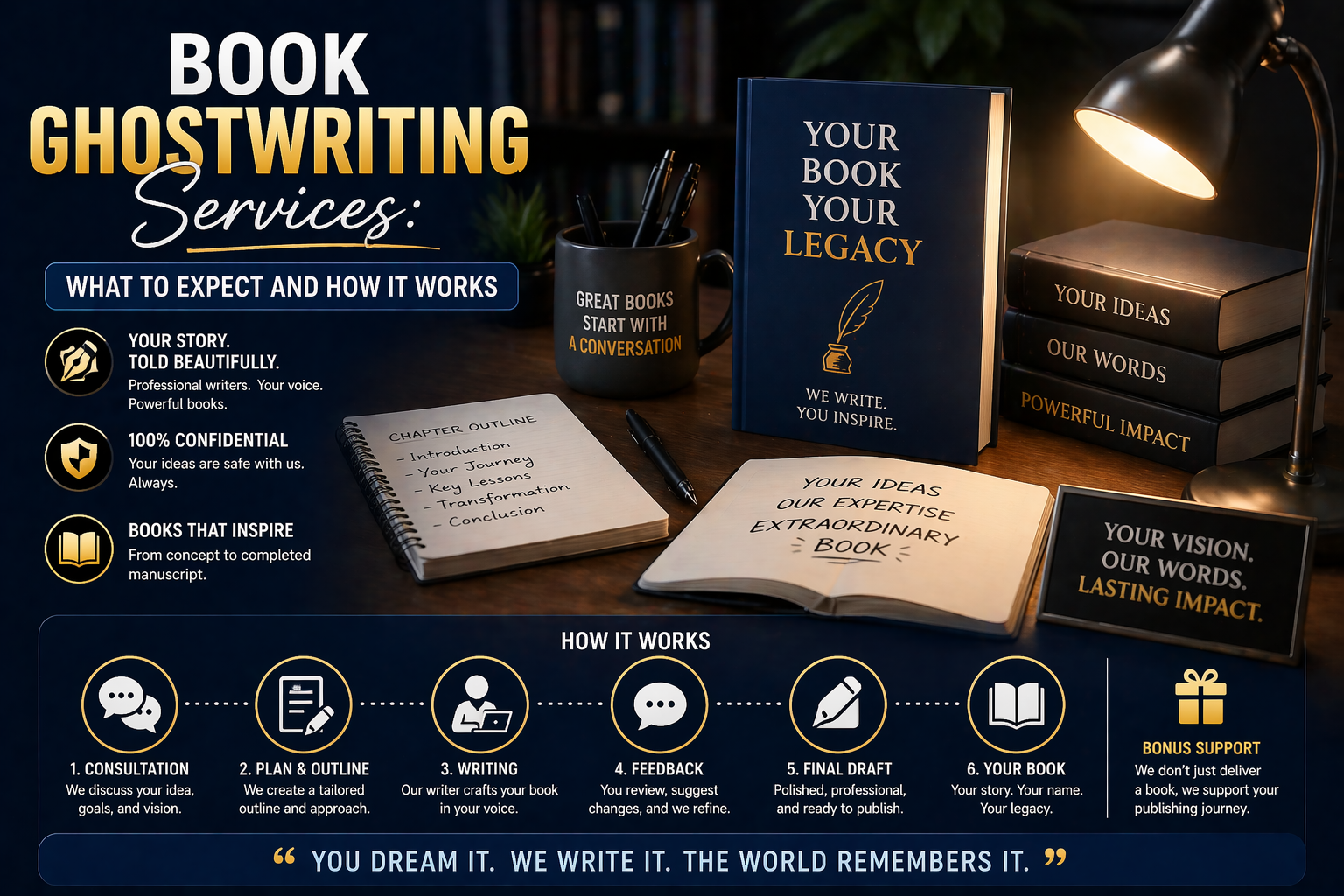
    Ghostwriting is the practice of hiring a professional writer to write a book — or any written work — on your behalf. The ghostwriter’s name does not appear on the cover. The book is entirely yours: your ideas, your voice, your story, your expertise. The ghostwriter is the skilled craftsperson who turns those raw materials into polished prose.

    Ghostwriting has a long and entirely reputable history. Speeches, memoirs, business books, political manifestos, celebrity autobiographies, and self-help bestsellers have been written with the help of ghostwriters for over a century. Many of the most celebrated books in the world were produced this way. The fact that a ghostwriter was involved says nothing about the authenticity of the ideas, the value of the content, or the credibility of the author.

    It says only that the author was smart enough to bring in the best possible help to ensure the book delivered on its potential.

    A Note on Authenticity Your ghostwritten book is not less ‘yours’ because a professional wrote it. The ideas, experiences, expertise, and voice that define the book come from you. The ghostwriter’s job is to capture and express them better than you could alone — the same way a speechwriter crafts words that a leader delivers as their own. The authenticity is in the ideas. The writing is a craft service.

    Who Hires a Book Ghostwriter?

    Ghostwriting clients span a much wider range than most people expect. The most common profiles include:

    Business Executives and Entrepreneurs

    You have built something remarkable. You have a perspective on leadership, industry, or innovation that other people genuinely need to hear. But running a company means you have neither the hours nor the focused energy to produce a 60,000-word manuscript. A ghostwriter conducts deep-dive interviews, extracts your best thinking, and produces the book that represents the full depth of your expertise.

    Coaches, Consultants, and Experts

    Your book is your highest-value marketing asset. It establishes you as the definitive authority in your niche, attracts premium clients, and generates speaking opportunities that your competitors without a book will never see. A ghostwriter helps you systematize your methodology into a readable, compelling framework that positions you exactly where you want to be.

    First-Time Authors with a Story to Tell

    Personal stories — memoirs, coming-of-age narratives, stories of resilience, reinvention, or survival — have enormous power. But translating a lived experience into a structurally sound, emotionally resonant narrative is a complex craft skill. A ghostwriter who specializes in narrative non-fiction or memoir can take your story and shape it into something that genuinely moves people.

    Professionals Entering a New Market

    If you’re building authority in a new space — launching a new business, shifting your brand positioning, or entering a new industry — a book is one of the fastest ways to establish credibility with a new audience. Ghostwriting accelerates that process dramatically.

    The Ghostwriting Process: Step by Step

    Ghostwriting process

    Every ghostwriting engagement is unique, but the professional process follows a consistent structure. Here’s how it works at Bookpress Publications:

    Phase 1: Discovery and Scoping

    The process begins with an in-depth consultation — typically one to two hours — where your ghostwriter gets to know you, your book idea, your audience, and your goals. This is where we ask the questions that matter: What is this book really about? Who needs to read it, and why? What do you want readers to feel, think, or do after finishing it? What do you already have — notes, talks, presentations, articles — that can inform the manuscript?

    At the end of discovery, your ghostwriter will produce a project brief that outlines the book’s concept, target audience, core argument, and proposed structure. This becomes the roadmap for the entire project.

    Phase 2: Outline Development

    Before a single chapter is written, a detailed chapter-by-chapter outline is developed and approved by you. This outline defines what each chapter covers, what it argues, what stories or examples it uses, and how it connects to the chapters before and after it.

    Skipping the outline phase is one of the biggest mistakes in any writing project. It leads to chapters that don’t connect, arguments that don’t build, and manuscripts that require expensive structural overhauls after the fact. A strong outline is the foundation of an efficient, high-quality writing process.
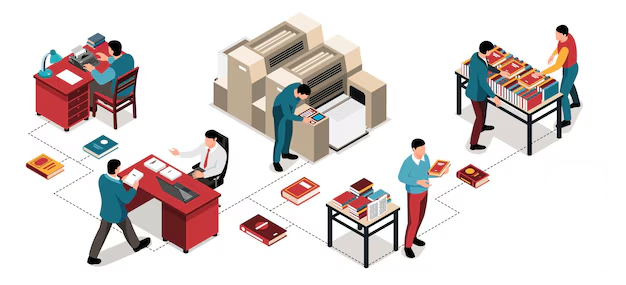
    Phase 3: Interviews and Research

    Your ghostwriter will conduct a series of structured interviews with you — typically recorded via video or voice call — to extract the raw material for each chapter. These interviews go deep: into your experiences, your thinking, your opinions, your stories, and the specifics that make your perspective unique.

    Alongside the interviews, your ghostwriter will conduct any additional research required to support the manuscript’s claims, add context, and ensure the content is current and accurate. The goal is a book that’s rich with your voice and grounded in substance.

    Phase 4: Writing the First Draft

    With the outline approved and interviews complete, your ghostwriter begins writing. Chapters are typically delivered in batches for your review, rather than all at once, so you can provide feedback as the manuscript develops and course-correct early if needed.

    The first draft focuses on getting the content right — structure, argument, storytelling, and flow. It won’t be perfect, and it’s not supposed to be. First drafts are for building the foundation. Refinement comes next.

    Phase 5: Revisions and Voice Calibration

    Your feedback on each chapter shapes the revisions. This is also where voice calibration happens in earnest. Your ghostwriter adjusts tone, vocabulary, rhythm, and style to match your natural voice as closely as possible. This is one of the most important and often underappreciated parts of the process — a well-ghostwritten book should be indistinguishable from something you wrote yourself on your best writing day.

    Most professional ghostwriting engagements include two to three rounds of revisions as standard. Major structural changes are addressed early; fine-tuning of voice and style continues throughout.

    Phase 6: Final Manuscript Delivery

    When you’re satisfied with the manuscript, your ghostwriter delivers a clean, formatted final draft ready for the editing phase. At this point, the manuscript moves to professional editing — developmental if needed, then copy editing and proofreading — before moving into design and production.

    Ghostwriting Timelines: What to Realistically Expect

    One of the most common questions is: how long will this take? The honest answer depends on the scope of the project, but here’s a realistic general framework:

    Project ScopeTypical Timeline
    Short business book (30,000–40,000 words)3–4 months
    Standard non-fiction (50,000–65,000 words)4–6 months
    Comprehensive memoir or expert book (70,000–90,000 words)6–9 months
    Complex research-heavy title (90,000+ words)8–12 months

    These timelines assume a reasonably engaged client who can commit to regular interview sessions and provides timely feedback on drafts. The ghostwriting process is collaborative — the more available and responsive you are, the smoother and faster it goes.

    What Makes a Great Ghostwriting Relationship?

    Great ghostwriting

    The best ghostwriting partnerships share a few consistent characteristics:

    • Openness and trust: The more freely you share your ideas, stories, and personality, the better the ghostwriter can capture your voice
    • Availability for interviews: Regular, focused interview sessions are the lifeblood of the project. Protecting this time is essential
    • Timely feedback: Slow revision cycles are the most common cause of project delays
    • Clear goals from the start: Knowing exactly what you want the book to achieve keeps the project focused and the ghostwriter aligned
    • Willingness to trust the craft: Your ghostwriter is a professional. Their suggestions about structure, narrative, and style are worth hearing — even when they push back
    On Confidentiality Professional ghostwriting is inherently confidential. At Bookpress Publications, all client engagements are covered by a comprehensive non-disclosure agreement. Your ghostwriter will not disclose that they wrote your book to anyone, ever. Your authorship is entirely protected.

    Ghostwriting vs. Co-Authoring: Understanding the Difference

    A related but distinct arrangement is co-authorship, where both you and the writer are credited on the cover. This is appropriate in some situations — particularly when the writer’s expertise or platform is itself a selling point for the book. Ghostwriting, by contrast, is a service arrangement where the writer’s contribution is not publicly acknowledged.

    GhostwritingCo-Authoring
    Your name only on the coverBoth names credited on the cover
    Writer’s contribution is confidentialWriter’s contribution is publicly acknowledged
    You retain all rights and royaltiesRights and royalties are negotiated and split
    Most common for memoirs, expert books, business booksCommon for collaborative projects, co-branded content
    Writer receives a flat fee or project rateWriter may receive fee plus royalty share

    Frequently Asked Questions

    Is ghostwriting ethical?

    Yes, unequivocally. Ghostwriting is a legal, widely practiced, and entirely ethical profession. There is no rule — legal, moral, or professional — that requires you to personally write every word in your book. The ideas, expertise, and authority behind the book are yours. The writing is a craft service, no different from hiring a professional photographer to represent your visual identity. The ethics question usually comes from those who haven’t encountered ghostwriting professionally — it tends to disappear entirely once they understand how the process works.

    Will my book sound like me?

    If your ghostwriter is good at their job, yes — emphatically. Voice capture is a core skill of professional ghostwriting. Your ghostwriter will study your existing writing, conduct extensive interviews, and iteratively refine the manuscript based on your feedback until the voice is authentically yours. Many clients tell us their ghostwritten book sounds more like them than anything they’ve written themselves — because the ghostwriter had the time and craft to distill their best thinking into its clearest expression.

    Who owns the copyright to a ghostwritten book?

    You do. In a professional ghostwriting arrangement, the writer produces the work under contract as a ‘work for hire,’ which means you own the copyright from the moment the contract is signed. The ghostwriter has no claim to the intellectual property, the royalties, or any future rights. This is standard practice and is always spelled out explicitly in the contract.

    How much does a professional book ghostwriter cost?

    Professional ghostwriting is a significant investment. Rates for experienced book ghostwriters in the United States typically range from $25,000 to $100,000 or more for a full-length manuscript, depending on the writer’s experience, the complexity of the project, and the depth of research required. Beware of very cheap ghostwriting services — they typically produce generic, low-quality content that doesn’t capture your voice or meet a professional publishing standard. A quality ghostwritten book is an asset that can generate returns for years; it deserves a commensurate investment.

    Can I ghostwrite a book if I already have a partial draft?

    Absolutely. Many clients come to Bookpress with notes, outlines, partial drafts, recordings of talks, or blog archives they want to develop into a book. Your ghostwriter will assess what you have, identify what’s usable, and build a plan to complete the manuscript from your existing material. This often accelerates the timeline and typically reduces the overall cost.

    Your Story Deserves to Be Told — Professionally

    Ghostwriting isn’t a shortcut. It’s a collaboration between your ideas and a professional’s craft — one that produces a book you couldn’t have written alone, not because your thinking isn’t valuable, but because writing a great book is its own specialized skill.

    The authors who work with professional ghostwriters don’t do so because they lack capability. They do so because they understand that the best outcome for their book — and for the readers it will serve — comes from bringing in the best possible expertise at every stage of the process.

    Ready to explore what ghostwriting your book could look like? The Bookpress Publications team offers a confidential, no-pressure initial consultation to discuss your book concept, answer your questions about the ghostwriting process, and give you an honest assessment of what your project would require. Let’s talk.

  • How to Self-Publish a Book in 2026: Step-by-Step for Beginners

    How to Self-Publish a Book in 2026: Step-by-Step for Beginners

    Self-publishing has never been more accessible — or more competitive. In 2026, anyone with a manuscript and an internet connection can upload a book to Amazon and call themselves a published author. But there’s a significant difference between uploading a file and publishing a book that actually reaches readers, earns reviews, and builds your reputation.

    This guide is for first-time authors who want to do it right. We’ll walk through every step of the self-publishing process — from finishing your manuscript to getting your book in front of the right readers — with honest advice about where to invest your time and money, and where the common mistakes happen.

    What This Guide Covers This is a complete step-by-step walkthrough of self-publishing in 2026: manuscript preparation, editing, cover design, formatting, choosing your publishing platform, pricing strategy, and marketing your launch. No steps skipped, no fluff.

    Why Self-Publishing Is a Legitimate Path in 2026

    Self-publishing concept

    The old stigma around self-publishing is gone. Some of the most successful authors in the world today are self-published, and the numbers back this up. Self-published authors on Amazon KDP can earn royalties of up to 70% on each sale, compared to the 10–15% typically offered by traditional publishers. They retain full creative control, keep all rights, and can publish on their own timeline.

    That said, self-publishing success doesn’t come from simply uploading a Word document. Readers have high expectations. The books that succeed are the ones that look and read professionally — because they were produced professionally, even if the author did it independently.

    Here’s exactly how to do that.

    The 10 Steps to Self-Publishing Your Book

    Editing and proofreading before publishing your book

    Let’s take a look at the 10-step process for self-publishing your book easily in 2026.

    Step 1: Finish and Polish Your Manuscript

    Before anything else, your manuscript needs to be complete. This sounds obvious, but many first-time authors jump into cover design or marketing before the writing is actually done. Resist the temptation. A finished, clean draft is the foundation everything else is built on. Write to the end, then do a full read-through before handing it to anyone. Fix obvious inconsistencies, remove filler sections, and ensure your beginning, middle, and end all deliver on the premise of your book.

    Step 2: Get Professional Editing

    This is the step that separates books people love from books they abandon after three pages. Professional editing is not optional if you want your book to compete. At minimum, your manuscript needs a copy edit (sentence-level clarity, grammar, consistency) and a proofread (the final clean-up before formatting). Ideally, you’ll also commission a developmental edit first — a structural review that looks at big-picture issues like argument flow, chapter organization, and narrative coherence. It’s the most expensive step, but it’s also the one that most directly determines the quality of the final product.

    Step 3: Design a Professional Cover

    Readers absolutely judge books by their covers. Research consistently shows that cover design is the number-one factor in a reader’s decision to click on or pick up a book. Your cover needs to do three things: communicate genre instantly, look professional at thumbnail size (because most readers first see it as a small image on Amazon), and stand out in your category. Do not attempt a DIY cover unless you have genuine graphic design experience. Hire a professional cover designer who specializes in your genre and understands how to design for the current market.

    Step 4: Format Your Interior for Print and Digital

    Formatting is what transforms your edited Word document into a book. Print formatting involves setting trim size, margins, fonts, chapter headers, page numbers, and other interior layout elements. Digital formatting (for ebook versions) requires a separate process that produces a reflowable file compatible with Kindle, Apple Books, Kobo, and other platforms. Poor formatting is one of the most common complaints in reader reviews of self-published books — widows, orphans, inconsistent spacing, and clunky chapter breaks all stand out immediately. Use a professional formatter or a publishing service that handles this step as part of their package.

    Step 5: Choose Your Publishing Platform(s)

    In 2026, your two primary self-publishing platforms are Amazon KDP (Kindle Direct Publishing) and IngramSpark. Amazon KDP gives you access to the world’s largest book retailer and is where most self-published books generate the majority of their sales. IngramSpark gives you access to a wider distribution network — including brick-and-mortar bookstores, libraries, and international markets. Many authors use both. If you publish exclusively on KDP, you can opt into KDP Select (which gives you access to Kindle Unlimited) but you must agree to exclusivity for 90-day rolling windows. Consider your audience, your goals, and your marketing strategy before deciding.

    Step 6: Get Your ISBN and Copyright

    An ISBN (International Standard Book Number) is your book’s unique identifier in the global book market. You can purchase your own ISBN through Bowker (the official US ISBN agency), or you can use the free ISBNs offered by Amazon KDP or IngramSpark. The important caveat: if you use a platform’s free ISBN, that platform is listed as your publisher of record. Buying your own ISBN means Bookpress Publications — or your own imprint name — appears as the publisher. For professionals building a serious author brand, owning your ISBN is worth the cost.

    As for copyright: in the United States, your work is automatically copyrighted as soon as it’s created. However, registering your copyright with the US Copyright Office gives you additional legal protections and the ability to sue for statutory damages in the event of infringement. Registration costs $35–$65 and is strongly recommended.

    Step 7: Set Your Price Strategically

    Pricing a self-published book requires balancing your royalty rate, your genre’s market norms, and your launch strategy. For ebooks on KDP, pricing between $2.99 and $9.99 earns you a 70% royalty. Below $2.99 or above $9.99, your royalty drops to 35%. Most successful self-published fiction ebooks are priced between $3.99 and $5.99. Non-fiction and professional books often command higher prices — $9.99 to $14.99 for ebooks is common. For print books, calculate your production cost through KDP’s royalty calculator and price accordingly, ensuring you make at least $1–3 per print sale after printing costs.

    Step 8: Build Your Author Platform Before You Launch

    The biggest mistake first-time self-publishers make is treating marketing as something you do after the book is published. By then, you’re starting from zero. Your author platform — your email list, your social media presence, your website, your relationships with reviewers and communities in your genre — should be built before launch day. Start at least three months before your publication date. Build a simple author website with a newsletter signup. Start sharing your writing journey on the social platforms where your readers are. Connect with book bloggers, reviewers, and communities who will genuinely want to read your book.

    Step 9: Launch With a Strategy

    A book launch is not an event — it’s a campaign. The most effective self-publishing launches in 2026 include several coordinated elements:

    • An ARC (Advance Review Copy) program: send free early copies to readers in exchange for honest reviews on launch day
    • A price promotion or free Kindle Countdown Deal in the first week to boost your visibility in Amazon’s algorithms
    • A coordinated social media and email push on launch day and throughout the first two weeks
    • Outreach to relevant podcasts, blogs, and publications in your niche for features, interviews, and reviews
    • Amazon advertising to amplify organic discovery immediately post-launch

    The goal in the first 30 days is momentum — reviews, sales velocity, and visibility all feed each other on Amazon’s algorithm. A strong launch creates a self-reinforcing cycle that drives long-term discoverability.

    Step 10: Market Your Book Consistently After Launch

    The launch is just the beginning. The books that succeed long-term do so because their authors treat marketing as an ongoing commitment, not a one-time event. This means maintaining your Amazon advertising campaigns, continuing to build your email list, regularly engaging with readers, and looking for new opportunities for features, reviews, and promotion. If your book is part of your professional brand, every speaking engagement, podcast appearance, or media mention should reference it. Consider enrolling in Kindle Unlimited if your genre’s readership skews to subscribers. And always be working on your next book — because the best marketing for a book is another book.

    The Most Common Self-Publishing Mistakes to Avoid

    Self-publishing mistakes

    Even with the best intentions, first-time self-publishers routinely make the same errors. Here are the ones that hurt most:

    • Skipping or under-investing in editing — no amount of great marketing rescues a poorly edited book
    • Using a DIY cover that signals ‘amateur’ to every reader who sees it in search results
    • Publishing before the manuscript is truly ready — you only get one first impression with your launch audience
    • Ignoring metadata — your book’s title, subtitle, description, and categories determine whether readers find it
    • Setting a price too low to seem accessible, then earning nothing per sale
    • Treating the launch as the finish line instead of the starting gun
    The Shortcut Worth Knowing Working with a full-stack publishing service like Bookpress Publications means you don’t have to navigate any of these steps alone. From editing and design to publishing setup and launch strategy, our team handles the complexity so you can focus on what only you can do — share your story and expertise with the world.

    Self-Publishing vs. Working With a Publishing Service: Which Is Right for You?

    True DIY self-publishing gives you the highest level of control and, if you do everything well, the highest royalty rate. But it requires significant time investment, a willingness to learn multiple new skills, and the ability to manage multiple vendors and deadlines simultaneously.

    For first-time authors — especially professionals, executives, and entrepreneurs who are writing to build their brand rather than to pursue a writing career — working with a professional publishing service typically produces a better book, faster, with far less stress.

    Think of it this way: you wouldn’t handle your own legal work because you technically could. You hire a professional because their expertise produces a better outcome in less time. Publishing your book is no different.

    Frequently Asked Questions

    How long does it take to self-publish a book?

    From a completed manuscript to a published book, the minimum realistic timeline is about three months — two for professional editing and design, one for formatting, platform setup, and launch preparation. Rushing the process almost always results in a lower-quality final product. If you’re starting from a rough draft or need ghostwriting, add two to four months before editing begins.

    How much does it cost to self-publish a book?

    Done properly, self-publishing a book in the United States costs between $2,000 and $10,000 or more, depending on manuscript length, editing depth, illustration requirements, and marketing investment. The single biggest costs are professional editing and cover design. Budget generously for both — they are the two factors that most directly impact how readers perceive and respond to your book.

    Do I need a literary agent to self-publish?

    No. Literary agents are relevant to the traditional publishing path, where they represent authors to publishers in exchange for a commission on deals. If you’re self-publishing, you’re bypassing the traditional publishing gatekeepers entirely, so no agent is needed. You deal directly with the publishing platforms, your service providers, and your readers.

    Can I self-publish and sell my book in bookstores?

    Yes, through IngramSpark’s distribution network, your self-published book can be made available to bookstores, libraries, and retailers worldwide. However, getting bookstores to actually stock your book on their shelves requires additional effort — including a returnable distribution arrangement, a professional cover and interior, and often a direct relationship with the store or a publicist. Most self-published authors generate the majority of their sales online.

    What’s the difference between self-publishing and vanity publishing?

    Self-publishing means you’re independently managing (or hiring professionals to manage) your book’s production and distribution, with you retaining all rights and royalties. Vanity publishing refers to companies that charge authors to publish their book without providing genuine editorial or creative quality. The distinction matters: a reputable full-stack publishing service like Bookpress Publications delivers professional standards at every stage. Vanity publishers take your money and produce a substandard product. Always ask to see examples of published books before signing with any publishing service.

    Your Book Is Within Reach

    Self-publishing in 2026 offers every author the opportunity to reach readers, build a brand, and share their message without a traditional publisher’s gatekeeping. The path is accessible — but the authors who succeed are the ones who approach it with the same professionalism they’d bring to any serious business endeavor.

    That means investing in quality editing, professional design, smart distribution, and a marketing strategy with real teeth. It means treating your book as the business asset it is, not a side project you’ll get to whenever there’s time.Ready to publish your book the right way? Bookpress Publications offers a free initial consultation to map out your publishing roadmap, identify exactly what your manuscript needs, and show you how our full-stack team can take you from where you are to a professionally published book — without the guesswork.

  • What Is Full-Stack Book Publishing? A Complete Guide for First-Time Authors

    What Is Full-Stack Book Publishing? A Complete Guide for First-Time Authors

    If you’ve ever Googled how to publish a book, you’ve probably been hit with a wall of options — and a lot of confusion. Self-publishing. Traditional publishing. Hybrid publishing. Ghostwriting. Editing. Marketing. The sheer number of moving parts can make the whole thing feel overwhelming before you’ve even written your first chapter. That’s exactly where the concept of full-stack book publishing services becomes a game-changer — especially if you’re a first-time author or a professional who wants to write a book without becoming an expert in the publishing industry overnight.

    At Bookpress Publications, full-stack book publishing is what we do. This guide breaks down exactly what it means, what it includes, and why it’s the smartest path for authors who want a polished, published book without juggling a dozen different vendors.

    The Publishing Problem Nobody Talks About

    Book publishing

    Here’s the reality most first-time authors discover too late: publishing a book isn’t one task. It’s at least six.

    You need someone to help you structure and write the manuscript. Someone else to edit it — ideally at multiple levels. A designer to create illustrations or a cover that actually sells. A publisher to format and distribute the book. A marketing team to build awareness and drive sales. And if you’re a busy professional, you probably need a ghostwriter too.

    Most people approach this piecemeal. They hire a freelance editor from one platform, a cover designer from another, a formatter from a third, and then try to figure out distribution themselves. The result? Inconsistent quality, missed deadlines, blown budgets, and a book that never reaches its potential.

    Full-stack book publishing solves this by putting everything under one roof — one team, one process, one vision for your book from idea to shelf.

    What ‘Full-Stack’ Actually Means

    The term ‘full-stack’ comes from software development, where a ‘full-stack developer’ handles both the front-end (what users see) and the back-end (the systems powering it) of a product. Applied to book publishing, it means a service that covers every layer of the publishing process — from the first word to the final sale.

    A full-stack book publishing company handles:

    • Manuscript development and ghostwriting
    • Professional editing at every stage
    • Custom illustration and cover design
    • Formatting and layout for print and digital
    • Publishing and distribution
    • Book marketing and promotion

    In short: you come in with an idea (or a rough draft), and you leave with a professionally published book — and the marketing strategy to sell it.

    Why This Matters for First-Time Authors First-time authors don’t know what they don’t know. A full-stack publisher acts as your guide through the entire journey, so you’re never left Googling ‘what does a developmental editor do’ at midnight before a deadline.

    The Five Pillars of Full-Stack Book Publishing

    Book editing

    Let’s break down exactly what a comprehensive, full-stack publishing service like Bookpress Publications covers:

    1. Ghostwriting Services

    Not every author is a writer — and that’s perfectly okay. Many of the most successful books on Amazon, in boardrooms, and on bestseller lists were written with the help of a professional ghostwriter. If you have expertise, a story to tell, or a message the world needs to hear but don’t have the time (or desire) to write it yourself, ghostwriting is the answer.

    A professional ghostwriter interviews you, captures your voice, organizes your ideas, and produces a manuscript that sounds exactly like you — only better. You own the copyright. Your name is on the cover. The ghostwriter stays behind the curtain.

    At Bookpress, our ghostwriting team works closely with first-time authors, business executives, coaches, and experts to turn their knowledge into compelling books.

    2. Book Editing Services

    Even the most gifted writers need an editor. Professional editing isn’t about fixing grammar — it’s about making your book the best version of itself. There are three core levels of editing every serious manuscript goes through:

    • Developmental Editing — The big-picture pass. Does the structure work? Is the argument compelling? Are there gaps in logic or narrative? This comes first.
    • Copy Editing — The line-by-line review. Sentence clarity, word choice, consistency, pacing, and style all get refined here.
    • Proofreading — The final check before print. Spelling, punctuation, formatting consistency, and typos are caught and corrected.

    Skipping any of these stages shows in the final product — and readers notice. A full-stack publisher builds all three into the process automatically.

    3. Book Illustration Services

    Whether you’re publishing a children’s book, a visual non-fiction title, or simply want a custom-illustrated cover that stands out in a crowded marketplace, professional illustration is one of the highest-impact investments you can make in your book.

    Great illustration doesn’t just make a book look beautiful. It reinforces your message, builds emotional connection with readers, and is often the single factor that determines whether someone picks your book up off the shelf — virtual or physical.

    A full-stack publisher has in-house or dedicated illustration talent, so your cover, interior artwork, and brand visuals are consistent, professional, and aligned with your book’s identity.

    4. Book Publishing Services

    ‘Publishing’ is itself a broad term that encompasses several distinct steps:

    • Interior layout and formatting for both print (trim size, margins, fonts) and digital (ebook formatting for Kindle, Apple Books, etc.)
    • ISBN assignment and copyright registration
    • Distribution setup — Amazon KDP, IngramSpark, Barnes & Noble, and other major retail channels
    • Print-on-demand or offset print run management
    • Metadata optimization — ensuring your book shows up when the right readers search for it

    A full-stack publisher handles every one of these steps, so nothing falls through the cracks and your book goes to market correctly the first time.

    5. Book Marketing Services

    Publishing a book is only half the battle. The other half is making sure the right people find it, read it, and tell others about it.

    Effective book marketing in 2026 requires a multi-channel approach:

    • Pre-launch strategy: building an audience and creating anticipation before the book is published
    • Launch campaign: coordinating reviews, press outreach, social media, and promotional pricing
    • Ongoing promotion: Amazon advertising, author website SEO, email marketing, and speaking opportunities
    • Author brand development: building your credibility and visibility as an expert in your field

    For business professionals and executives, a book is one of the most powerful credibility signals in existence. But it only delivers that value if people know it exists — which is why marketing is a non-negotiable part of the full-stack equation.

    Why Full-Stack Publishing Is the Smarter Choice

    Let’s be honest: you could piece together all of the above yourself. You could find a freelance ghostwriter on one platform, a developmental editor on another, a cover designer somewhere else, figure out KDP distribution yourself, and then try to market the book through trial and error.

    Many first-time authors try exactly this. Here’s what usually happens:

    • Communication breaks down between vendors who’ve never worked together
    • The editing stage takes twice as long because the ghostwriter and editor have conflicting styles
    • The cover looks nothing like the interior illustrations
    • Distribution is set up incorrectly, and the book is either not discoverable or not profitable
    • Marketing is an afterthought because there’s no budget or energy left

    The full-stack model eliminates every one of these failure points. Your project has a single point of contact, a unified creative direction, and a team that has done this hundreds of times before.

    The Real Value of Full-Stack Publishing It’s not just about convenience. It’s about the quality of the final product. A book produced by a coordinated, professional team is measurably better — and better-selling — than one stitched together from disconnected freelancers.

    Who Is Full-Stack Book Publishing For?

    Books getting printed

    The short answer: anyone who wants a professionally published book without becoming a publishing expert themselves. But let’s be more specific.

    First-Time Authors

    You have a story, a message, or a body of expertise. You’ve always wanted to write a book. But you don’t know where to start, don’t have time to research every step of the publishing industry, and want to know that the end product will be something you’re proud to put your name on. Full-stack publishing is built for you.

    Business Professionals and Executives

    A book is one of the most powerful things you can do for your professional brand. It establishes you as a thought leader, creates speaking opportunities, generates leads, and opens doors that no business card or LinkedIn profile ever could. But writing and publishing a book while running a business is an enormous undertaking — unless you have a team that handles everything while you focus on the content and your business.

    Entrepreneurs and Coaches

    Your book is both a credibility asset and a lead generation tool. A well-marketed business book can drive inbound clients for years after it’s published. The full-stack model ensures it’s built and launched as a proper business asset, not a vanity project.

    What to Look for in a Full-Stack Book Publishing Company

    Not all publishers that claim to be ‘full-stack’ actually are. When evaluating your options, here are the questions that matter:

    1. Do they offer all five core services in-house, or do they outsource key steps to third parties?
    2. Can they show you examples of books they’ve taken from manuscript to market?
    3. Do they have a dedicated point of contact who manages your project end to end?
    4. Do they offer transparent pricing with no hidden costs at each stage?
    5. Do they have publishing experience specifically in your genre or category?
    6. What does their marketing support actually include — or does it end at distribution?

    The right publisher answers yes to all of the above and can back it up with real results. At Bookpress Publications, we’ve built our entire service model around these standards, because we know that for first-time authors and busy professionals, the process needs to be as seamless as the outcome.

    Frequently Asked Questions

    How long does the full-stack publishing process take?

    It depends on where you start. If you already have a completed manuscript, the process from editing to published book typically takes three to six months. If you’re starting with a ghostwriting project, add two to four months for the writing stage. For complex projects with extensive illustration, timelines vary — your publishing team will give you a specific timeline based on your project during the initial consultation.

    Do I retain the rights to my book with a full-stack publisher?

    With reputable full-stack publishers, yes — absolutely. You own your manuscript, your cover art, your ISBN, and all publishing rights. A good publishing partner is a service provider, not a traditional publisher taking a cut of your royalties. Always confirm this before signing any agreement.

    Is full-stack book publishing the same as vanity publishing?

    No. Vanity publishing charges authors to publish without providing meaningful editorial, creative, or marketing quality. Full-stack publishing is a professional service model where every deliverable — editing, design, distribution, and marketing — is held to industry standards. The distinction is quality, transparency, and genuine value delivered at each stage.

    What if I already have a manuscript — can I still use full-stack services?

    Absolutely. Many authors come to Bookpress with a completed draft and simply need editing, design, publishing, and marketing support. You can engage the full service stack or just the components you need — the team will assess your manuscript and recommend the right starting point.

    How much does full-stack book publishing cost?

    Costs vary significantly based on manuscript length, the scope of services required, illustration complexity, and marketing investment. A full-service package typically represents a meaningful investment — but one that pays dividends in the quality of the final product and the longevity of your author brand. Bookpress offers a free consultation to walk through your project and provide transparent, itemized pricing.

    Your Book Deserves More Than a Patchwork Process

    Publishing a book is one of the most meaningful things you can do as a professional, an expert, or a storyteller. It deserves a process that matches that significance — one that’s coordinated, professional, and built to produce the best possible outcome.

    Full-stack book publishing is how Bookpress Publications brings that process to life for first-time authors and seasoned professionals alike. From your first conversation with our team to the day your book appears in readers’ hands, every step is handled with the same standard of care.

    Ready to start your publishing journey? Book a free consultation with the Bookpress Publications team today, and let’s map out exactly what your book needs to go from idea to published reality.