“My manuscript just needs a quick proofread.” This is one of the most common things first-time authors say before working with a professional editor — and it’s almost never true. Not because authors are wrong about their writing, but because most authors don’t yet have a clear picture of what professional book editing actually involves, how many distinct stages it encompasses, or what each one does for a manuscript.
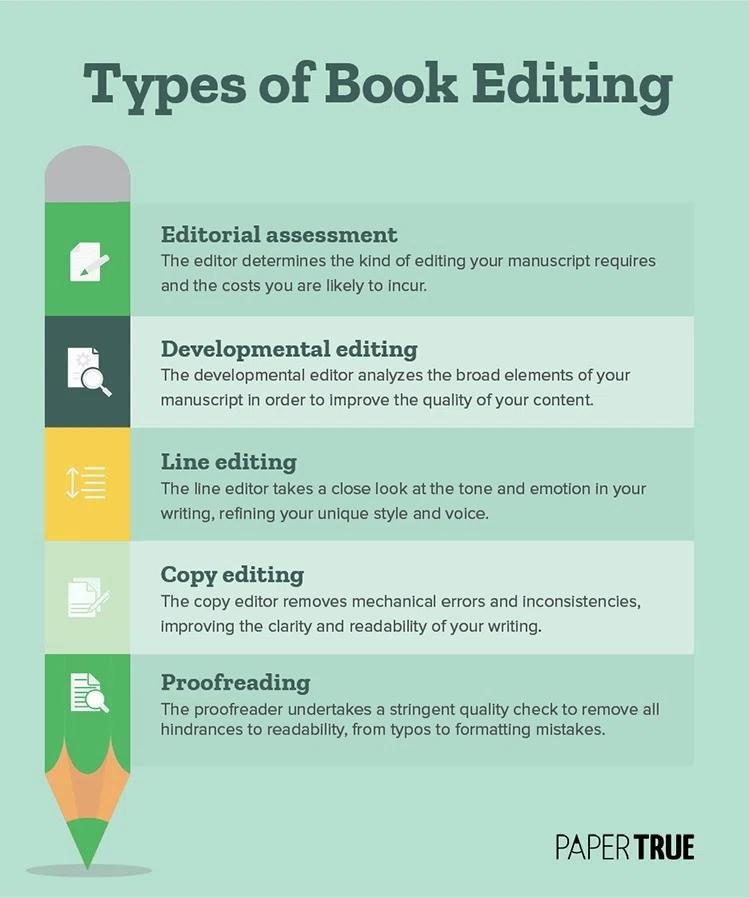
Professional book editing is not one thing. It is four distinct types of editorial work, each addressing a different dimension of quality, applied in a specific sequence. Understanding the difference between developmental editing, copy editing, proofreading, and beta reading — and knowing which ones your manuscript needs — is the foundation of a successful publishing process.
This guide explains all four clearly, tells you when each applies, and gives you a practical framework for deciding what your specific manuscript needs.
| The Core Principle Every layer of editing addresses a different set of questions. Developmental editing asks: Does this book work? Copy editing asks: Does this writing work? Proofreading asks: Is this text clean? Beta reading asks: Does this land with a real reader? Each is essential. None substitutes for the others. |
The Four Types of Book Editing

Let’s explore the various types of book editing that you might come across.
1. Developmental Editing
Developmental editing — sometimes called structural editing or substantive editing — is the highest-level, most comprehensive form of editorial feedback. A developmental editor reads your entire manuscript and evaluates it as a whole, focusing on the big questions:
- Does the book’s central argument or premise hold together from beginning to end?
- Is the structure logical? Are chapters in the right order? Does the book build effectively toward its conclusion?
- Are there gaps in the argument — sections where a reader will be confused, unconvinced, or left without the information they need?
- Is the pacing right? Are some sections too dense, others too thin?
- Does each chapter serve a clear purpose, and does it deliver on that purpose?
- Is the opening compelling enough to hold a reader’s attention? Does the ending satisfy?
A developmental editor will typically deliver a detailed editorial letter (often 5–15 pages) outlining their findings, along with inline comments throughout the manuscript. They are not correcting sentences — they are assessing and improving the architecture of the book.
When do you need developmental editing?
If you’ve written a complete first or second draft and you’re not certain whether it’s working — whether the structure is sound, whether the argument is compelling, whether the pacing holds — you need a developmental edit. This is especially important for first-time authors, for complex nonfiction with multi-layered arguments, and for any book where the overall conceptual framework is central to its value.
Developmental editing is also the right choice if you’ve received feedback from beta readers or early readers that something “isn’t quite working” but you can’t identify what. A developmental editor will find it.
When can you skip developmental editing?
For simple, tightly scoped manuscripts — a short practical guide with a clear structure, a straightforward memoir with a linear timeline — a developmental edit may be unnecessary if you’ve already received substantive feedback on the structure and are confident it’s sound. But for most authors, especially first-time authors, skipping developmental editing is a risk. The cost of discovering structural problems after the book is published is far higher than the cost of fixing them before.
2. Copy Editing
Copy editing operates at the sentence and paragraph level. Where a developmental editor asks “does this book work?”, a copy editor asks “does this writing work?” These are fundamentally different questions — and a manuscript that has passed developmental editing can still have significant copy editing needs.
A copy editor addresses:
- Clarity — Are sentences clear and easy to understand? Are there ambiguous phrasings that could confuse a reader?
- Consistency — Are character names, terminology, dates, and facts consistent throughout the manuscript?
- Style and voice — Is the writing consistent in tone throughout? Does the author’s voice remain stable, or does it shift in ways that feel jarring?
- Grammar and usage — Are there grammatical errors, awkward constructions, or usage issues that undermine the prose?
- Sentence variety and rhythm — Is the prose monotonous, or does it have the rhythm and variety that makes reading pleasurable?
- Word choice — Are words chosen precisely? Are there places where a different word would be more accurate, more vivid, or more appropriate?
Copy editing is typically delivered as a tracked-changes document, with queries and comments from the editor where decisions are needed from the author.
When do you need copy editing?
Every manuscript that will be published for a general audience needs copy editing. Full stop. This applies whether you’re a strong writer or a first-time author, whether your manuscript has already been through developmental editing or not. The reason is simple: no author can see their own manuscript with the detached, precise eye of a professional editor who is reading it for the first time. You know what you meant to say; a copy editor reads what you actually said.
Copy editing is non-negotiable if you want your book to be taken seriously by readers. The absence of professional copy editing is immediately apparent to experienced readers and is one of the most common reasons for negative reviews of self-published books.
3. Proofreading
Proofreading is the final editorial stage before a manuscript is sent to layout or uploaded for publication. It is not the same as copy editing — and cannot substitute for it.
A proofreader reads the nearly-final manuscript (or, ideally, the formatted page proofs) with one specific purpose: to catch anything that slipped through copy editing. This includes:
- Typos and spelling errors that were missed or introduced during copy editing revisions
- Punctuation inconsistencies
- Formatting irregularities — inconsistent spacing, stray characters, incorrect font changes
- Headers and chapter titles that don’t match the table of contents
- Captions, footnotes, or endnotes that contain errors
- Any factual inconsistencies in proper names, dates, or figures
Proofreading is typically done on the formatted, near-print-ready document — so errors in layout (widows, orphans, incorrect hyphenation) can also be caught at this stage.
When do you need proofreading?
Always — for any book that will be published. Proofreading is the last line of defence before your book reaches readers. Even if your copy editor was excellent and thorough, errors slip through. New errors can be introduced during author revisions. The formatting process itself can introduce inconsistencies. Proofreading is the safety net that catches all of this.
4. Beta Reading
Beta reading is a distinct form of feedback that sits alongside the professional editing process rather than within it. A beta reader is typically not a professional editor — they are a representative member of your target audience who reads your manuscript and provides feedback from a reader’s perspective.
Beta readers respond to questions like:
- Was there a point where you felt the book lost you or your interest flagged?
- Were there sections you found confusing, unconvincing, or unclear?
- Did the opening compel you to keep reading?
- Was the conclusion satisfying?
- What was the most valuable part of the book for you?
- Is there anything you expected the book to cover that it didn’t?
Beta reading is particularly valuable for fiction and narrative non-fiction, where the reader experience — pace, tension, emotional resonance — is central to the book’s success. It is also valuable for any book where the author is uncertain whether the intended audience will respond as hoped.
When should you use beta readers?
Ideally, after a developmental edit and before copy editing. At this stage, the structure is sound, but there’s still time to make meaningful changes based on reader feedback. Beta reading after copy editing is less useful because significant revisions post-copy-edit create additional editing work.
Editing at a Glance: How the Four Types Compare
| Developmental Edit | Copy Edit | Proofreading | Beta Reading | |
| Primary Focus | Big-picture structure & argument | Sentence-level clarity & style | Final errors & typos | Reader experience & comprehension |
| When in Process | After first complete draft | After developmental edit | After copy edit | Can occur at any draft stage |
| What It Changes | Structure, chapters, sections, pacing | Sentences, paragraphs, word choice | Typos, punctuation, consistency | Perspective on what’s unclear or missing |
| Who Does It | Specialist developmental editor | Experienced copy editor | Professional proofreader | Trusted readers or paid beta readers |
| Typical Cost (60K words) | $3,500–$7,000 | $2,000–$5,000 | $900–$2,000 | $200–$800 or free |
| Essential? | Highly recommended | Yes — non-negotiable | Yes — non-negotiable | Valuable but optional |
The Right Editing Sequence for Your Manuscript

If your manuscript needs all four types of editing, the correct sequence is:
- Beta reading (optional, but valuable — get reader perspective while the manuscript is still flexible)
- Developmental editing — assess and fix the architecture before line-level work begins
- Author revisions — implement changes from the developmental edit
- Copy editing — sentence and paragraph level refinement of the revised manuscript
- Author review — respond to copy editor’s queries and approve changes
- Layout / formatting — design and format the final manuscript
- Proofreading — final quality check on the formatted, near-print-ready document
This sequence matters. Doing copy editing before developmental editing is one of the most common (and expensive) mistakes authors make — because if the developmental edit recommends significant structural changes, the copy-edited sections may need to be substantially rewritten, wasting the copy editing investment.
| What Bookpress Publications Recommends For most first-time authors and professional authors, we recommend at minimum: developmental editing (or a detailed structural assessment), copy editing, and proofreading. For complex manuscripts, research-heavy non-fiction, or books that are central to your professional brand, invest in all stages. The quality difference between a book that has been through full professional editing and one that hasn’t is immediately apparent to readers — and the investment is recoverable many times over through sales, reputation, and opportunity. |
Frequently Asked Questions
Can I skip developmental editing if I’ve already had friends or colleagues read my manuscript?
Feedback from people who know you — or who aren’t professional editors — is valuable, but it is not a substitute for developmental editing. Friends and colleagues tend to be encouraging, tend not to flag structural problems clearly, and don’t have the editorial framework to identify and articulate what specifically isn’t working. A professional developmental editor brings a trained, objective eye that non-professionals simply can’t replicate.
How do I find a good book editor?
Look for editors who specialize in your genre or category, have verifiable experience with published books, can provide references or testimonials from previous authors, and whose editorial style feels like a good fit based on a sample edit. Professional associations like the Editorial Freelancers Association (EFA) and the American Copy Editors Society (ACES) maintain directories of qualified editors. At Bookpress Publications, our editorial team is matched to each project based on genre expertise and manuscript needs.
Can the same editor do both developmental editing and copy editing?
Some editors are skilled at both, but many specialize in one or the other. Developmental editing requires a high-level, structural perspective; copy editing requires meticulous line-by-line attention. Using the same editor for both is possible but can be less effective than using specialists for each stage, because the perspectives required are genuinely different. A full-service publisher like Bookpress coordinates the right editorial expertise for each stage.
How many rounds of editing does a typical book need?
Most manuscripts go through one round of developmental editing (with one round of author revisions), followed by one round of copy editing (with author review), followed by one proofread. Particularly complex manuscripts, or those with significant structural issues identified in developmental editing, may require a second structural pass before moving to copy editing. Additional rounds add time and cost but are sometimes necessary to reach the quality standard the book deserves.
What’s the difference between a line edit and a copy edit?
These terms are often used interchangeably, but technically a line edit focuses on style, voice, and the overall quality of the prose at a sentence level — it is more creative and interpretive than copy editing. Copy editing is more technical, focusing on grammar, consistency, fact-checking, and adherence to a style guide. Many professional editors offer “copy editing with a line edit focus,” which combines both. Ask your editor what their process includes before engagement.
Your Manuscript Deserves Every Stage
The difference between a book that earns five-star reviews, drives business outcomes, and stands the test of time — and one that gets quietly returned and forgotten — is almost always editorial. Not because the ideas were different, but because one was professionally edited and one wasn’t.
Understanding the four types of editing and what each one does is the first step toward making the right investment in your book. The second step is working with a team that brings genuine expertise to each stage.
Bookpress Publications offers professional book editing services at every stage — developmental, copy editing, and proofreading — delivered by experienced editors matched to your genre and manuscript. Book a free consultation to discuss your manuscript’s editing needs and get a clear, itemized picture of what the process involves for your specific project.
Leave a Reply