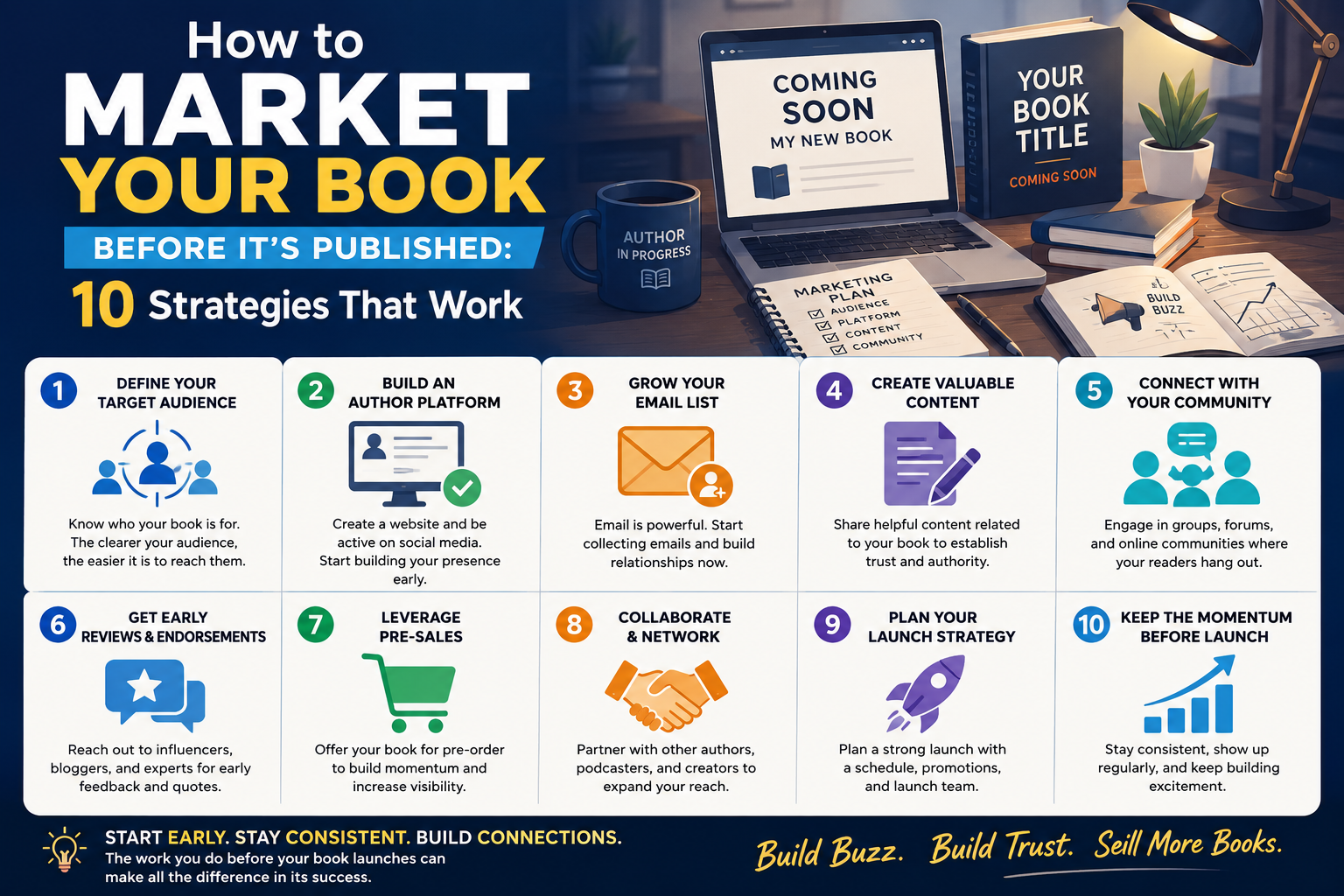
Most first-time authors treat book marketing as something that begins on publication day. It doesn’t. By the time your book is published, the most important window for building momentum — the months before launch when your potential audience is being cultivated, your early readers are being recruited, and your visibility is being built — has already passed.
The most successful book launches in 2026 are not accidents. They are the result of a deliberate pre-launch marketing strategy that starts three to six months before publication day and builds the audience, anticipation, and social proof that turns a launch from a quiet release into a genuine event.
Here are ten strategies that consistently work — whether you’re a first-time author building from zero or a professional leveraging an existing platform.
| When Should You Start Pre-Launch Marketing? The minimum recommended pre-launch window is 90 days. Six months is better. Twelve months, for a major title tied to a professional brand or business, gives you the most room to build. The earlier you start, the more organic momentum you can generate before launch day — and organic momentum is what drives the review velocity and sales ranking that sustains a book after the initial push. |
Strategy 1: Build Your Author Email List Before Anything Else

An email list is the single most valuable pre-launch marketing asset you can own — more valuable than social media followers, more reliable than algorithm-driven reach, and more controllable than any platform you don’t own. When your book launches, your email list is the first audience you activate: they buy first, review first, and tell others first. Their early activity drives the algorithmic momentum that carries the book to new readers.
Start building your list the moment you commit to publishing. Offer a meaningful incentive: a sample chapter, a companion resource, a free guide related to your book’s topic. Your signup page should be live before your cover is designed, before your publishing date is set, and certainly before any other marketing activity begins.
The goal isn’t a massive list — it’s a list of genuinely interested, engaged readers who are waiting for your book. Even 500 subscribers who actively want your book are worth more than 5,000 who vaguely remember signing up.
Strategy 2: Create a Pre-Launch Author Website
Your author website is your central hub — the one place on the internet that you fully control and that anchors every other marketing channel. Before launch, it should include: your book’s title, cover (once available), and a compelling description; an email signup prominently placed; your author bio and credibility indicators; a pre-order or notify-me link as soon as your publication date is set; and a blog or resources section that gives you fresh content to share and a reason for people to return.
Your website also serves an important SEO function. Publishing regular content about your book’s topic builds organic search visibility over the months before launch, so readers who are searching for exactly what your book covers can find you before it’s even available.
Strategy 3: Leverage Social Media for Audience Building — Not Just Announcements

The mistake most pre-launch authors make on social media is treating it as a broadcast channel: announcing milestones, posting cover reveals, and counting down to launch day. These things have their place, but they are not how you build an audience.
You build a social media audience by being genuinely useful and interesting on the topic your book covers, consistently, over time. Share your research. Discuss the ideas in your book. Ask questions that invite conversation. Share your writing and publishing journey authentically. Give value to the people you want to reach — and when your book launches, they’ll feel invested in your success because they’ve been part of the journey.
Choose one or two platforms where your specific audience actually spends time and go deep there. LinkedIn is non-negotiable for business and professional books. Instagram and TikTok are powerful for narrative non-fiction, memoir, and creative non-fiction. Pinterest drives significant traffic for lifestyle, design, and how-to content.
Strategy 4: Set Up Pre-Orders
Pre-orders serve two critical functions. First, they generate cash flow before your book is published. Second — and more importantly — on Amazon, pre-order sales accumulate and count toward your sales rank on launch day, which means a month of pre-order activity can catapult your book into high rankings at the exact moment you need maximum visibility.
Set up your pre-order on Amazon KDP and IngramSpark as soon as your book’s metadata (title, description, cover) is finalized — even if the interior is still being edited. Promote your pre-order link in every email, on your website, and across all social channels. Offer a meaningful incentive for pre-ordering: bonus content, a signed bookplate, early access to a companion resource, or a personal thank-you.
Strategy 5: Recruit an ARC (Advance Review Copy) Team

Reviews are the social proof that turns browsers into buyers — and the time to build your review base is before launch day, not after. An ARC (Advance Review Copy) program involves sending free early copies of your book to a selected group of readers in exchange for honest reviews posted on or around launch day.
ARC readers can be recruited from your email list, your social media following, relevant online communities in your genre, and book review bloggers and influencers. Send your ARC copies four to eight weeks before your publication date — long enough for readers to finish the book and write their review before launch.
A book that launches with 20–30 genuine, verified reviews has a dramatically different trajectory than one that launches with zero. Those early reviews provide social proof to new readers, improve your Amazon ranking algorithm, and give you quotable material for your marketing.
Strategy 6: Pitch Podcasts and Media
Podcast appearances are one of the most effective pre-launch visibility strategies available to authors in 2026, because they reach concentrated, highly engaged audiences who are already interested in the topic your book covers. A well-chosen podcast with 10,000 listeners in your exact niche is worth more than a generic media mention that reaches a million unqualified readers.
Start pitching podcasts three to four months before your launch date. You don’t need a published book to be a podcast guest — you need an interesting perspective, a compelling story, and the ability to provide genuine value to the show’s audience. Your book’s impending publication is itself a news hook. Lead with what you can offer the audience; the book mention follows naturally.
The same logic applies to written media: relevant industry publications, newsletters in your niche, and blogs that serve your target reader. A guest article that showcases your expertise and mentions your upcoming book reaches an audience that was already looking for what you’re writing about.
Strategy 7: Build Community Around Your Book’s Topic

The most durable author brands are built not just around the author’s name but around the community of people who care about the same things the author writes about. Before your book launches, identify where that community already exists — and start participating genuinely and consistently.
For business and professional books: LinkedIn groups, industry associations, professional communities, and relevant subreddits. For non-fiction: Facebook groups, online forums, newsletters in your niche. For memoir and narrative non-fiction: literary communities, writing groups, communities organized around the experience or theme your book explores.
You’re not there to promote your book. You’re there to contribute, help, and be recognized as someone worth paying attention to. The book promotion is what happens organically when people in those communities want to read what you’ve written.
Strategy 8: Create a Launch Team
A launch team is a group of committed supporters who agree to help amplify your book on and around launch day. Unlike ARC readers (who are primarily reading for the purpose of reviewing), launch team members are enthusiastic advocates who will share, recommend, and actively promote your book in exchange for exclusive access, early content, and the satisfaction of being part of something.
Recruit your launch team from your most engaged email subscribers, your closest professional network, and readers who have already expressed enthusiasm about your work. Give them advance content, behind-the-scenes access, and clear, specific actions to take on launch day: post their review, share on social media, recommend to a specific person, mention in a newsletter. The coordinated action of even 30–50 committed launch team members on a single day creates a measurable spike in visibility.
Strategy 9: Use Content Marketing to Build Pre-Launch SEO

Every blog post, article, or video you publish about your book’s topic in the months before launch is building organic search visibility that will continue to work for you long after the launch. A well-optimized piece of content targeting a keyword your potential readers search for can drive traffic to your pre-order page — or to your email list — for months before your book is even available.
This is especially valuable for professional and non-fiction authors, because your book’s topic almost certainly has search demand from people who need exactly what your book offers. Publishing content that serves that demand early builds your site’s domain authority and ensures you’re visible to the audience that matters most when your book is ready.
Strategy 10: Engage Your Existing Network With a Personal Touch
Your personal and professional network is often the most overlooked pre-launch marketing asset — and frequently the most powerful one for generating the early reviews, shares, and word-of-mouth that launch momentum depends on. The people who know you, respect your work, and want you to succeed are your most reliable early advocates.
Don’t mass-email your entire contact list with a generic announcement. Instead, identify the 50–100 people in your network who are most likely to be genuinely interested in your book and reach out personally — by email, by message, or by phone. Tell them about your book, explain why you think it would be relevant to them specifically, and ask directly: would you be willing to pre-order, leave a review, or share it with one person in your network? Personal outreach converts dramatically better than broadcast, and it costs nothing except time.
Pre-Launch Marketing Timeline
Here’s how to sequence these ten strategies across a 90-day pre-launch window:
| Timeline | Actions to Complete |
| 6+ months out | Begin building email list, set up author website, start social media presence, define target audience clearly |
| 4–5 months out | Begin pitching podcasts and media, start community engagement, draft ARC list, publish first SEO content pieces |
| 3 months out | Finalize cover and book description, set up pre-order, launch ARC program, begin launch team recruitment |
| 2 months out | Send ARCs to reviewers, continue podcast and media outreach, intensify social media content, send pre-order announcements to email list |
| 1 month out | Follow up with ARC readers, brief launch team on day-of actions, schedule social media content, finalize any promotional pricing for launch week |
| Launch week | Coordinate launch team activity, send launch-day email, go live on all channels, post reviews and shares, monitor and respond to early activity |
Frequently Asked Questions
How big does my audience need to be before my book launches?
There is no minimum. A small, highly engaged audience of people who genuinely want your book will outperform a large, passive audience every time. Focus on quality of engagement over quantity of followers. 200 email subscribers who are excited about your book will drive more launch day reviews and sales than 2,000 social media followers who barely remember why they followed you.
What if I’m starting from zero — no email list, no social following, no existing platform?
Then you start building one today. The strategies in this guide all work from zero — they just require more time. This is the strongest argument for starting your pre-launch marketing as early as possible: the earlier you start, the more time you have to build the audience that will make your launch successful. Even three months of consistent effort on email list building and social media content will produce a meaningfully better launch than starting the week before publication.
How do I find ARC readers if I don’t have an existing audience?
Several platforms specialize in connecting authors with ARC readers: NetGalley, BookSirens, and Edelweiss are the most widely used. Genre-specific ARC communities also exist on platforms like Facebook, Goodreads, and Reddit. For professional and business books, your professional network — colleagues, clients, peers in your industry — is often the richest source of qualified ARC readers.
Should I spend money on pre-launch advertising?
Pre-launch paid advertising can be effective, but only once your landing page or pre-order link converts well organically. Driving paid traffic to a weak landing page wastes budget. Focus first on optimizing your pre-order or email signup page, then consider paid promotion in the final 30 days before launch to amplify what’s already working. Email list building ads on Meta (Facebook and Instagram) can be particularly cost-effective for audience building well in advance of launch.
How does Bookpress Publications support the pre-launch marketing process?
Bookpress Publications offers comprehensive book marketing services that include pre-launch strategy development, ARC program management, author website setup, content planning, and launch campaign coordination. Rather than figuring out the marketing alongside the editing and publishing process, our authors work with a dedicated marketing team that integrates their launch strategy with their publication timeline from day one. Book a free consultation to discuss how we can support your specific launch.
Your Launch Day Starts Today
The single most common regret among self-published authors is not starting their marketing earlier. The book was edited, the cover was beautiful, the formatting was professional — but the marketing was left for after publication, which meant the launch day arrived with no audience to receive it.
The ten strategies in this guide are not complicated. They don’t require a large budget, a dedicated marketing team, or years of experience. They require consistency, genuine investment in building relationships with your future readers, and the willingness to start before you feel ready.
Bookpress Publications’ book marketing team helps authors build pre-launch audiences and execute launches that generate real results. Book a free consultation to discuss your book’s marketing strategy and find out how our team can support your journey from manuscript to bestselling author.
Leave a Reply