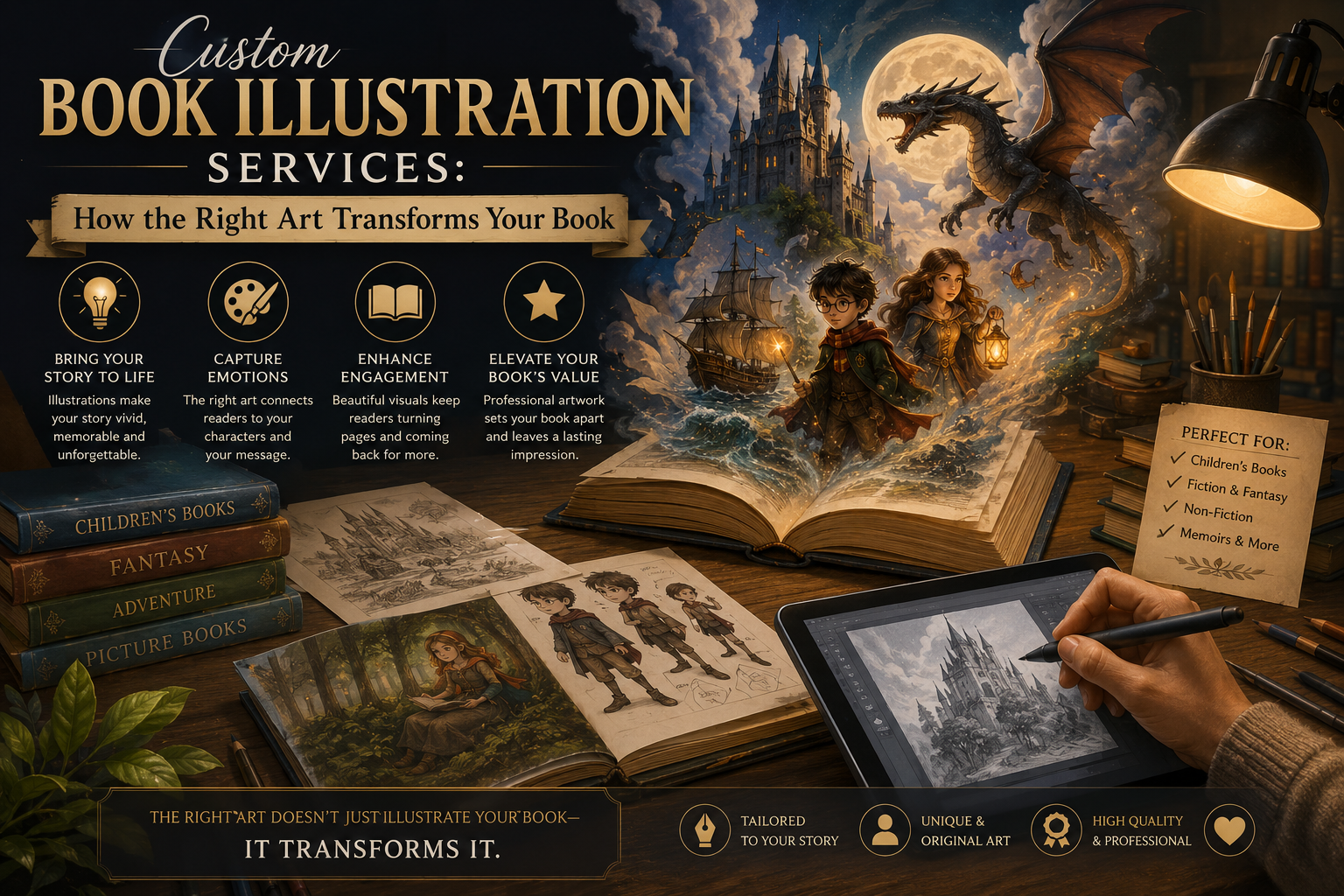
Walk into any bookstore — or scroll through any section of Amazon — and pay attention to what your eyes do. They don’t read titles first. They see images. A cover catches your eye before a single word registers. An illustration stops your scroll in a feed of text. Art communicates what prose takes paragraphs to establish: tone, genre, emotional register, and quality — all in a fraction of a second.
Professional book illustration isn’t decoration. It’s a fundamental component of your book’s ability to attract, engage, and retain readers — and in 2026, it’s one of the most significant differentiators between books that get noticed and books that don’t. This guide covers what custom book illustration services involve, where illustration adds the most value, how to choose the right illustrative style for your project, and what to expect from the professional illustration process.
What Is Custom Book Illustration?
Custom book illustration refers to original artwork created specifically for your book — not stock images, not AI-generated graphics, not adapted clip art, but professionally crafted visual work designed to serve your book’s specific needs. Custom illustration encompasses:
- Cover design and illustration — the primary image that represents your book to the world
- Interior spot illustrations — images placed throughout the text to break up content, reinforce ideas, or carry the narrative
- Full-page interior illustrations — particularly common in children’s books, picture books, and visually-driven non-fiction
- Character design and development — establishing consistent visual identities for recurring characters
- Maps, diagrams, and informational graphics — for non-fiction, educational, and reference titles
- Chapter header art — decorative or thematic illustrations that open each chapter
The scope of illustration work varies enormously by book type. A children’s picture book may require 24–32 full-color spreads. A business non-fiction title may need only a custom cover and a handful of interior diagrams. A fantasy novel may benefit from a map, chapter headers, and a distinctive cover. Understanding what your specific book needs — and what each type of illustration contributes — is the starting point for a smart illustration investment.
Where Illustration Makes the Biggest Difference

Children’s Books and Picture Books
In no book category is illustration more central to the product than children’s books. For picture books (typically ages 3–8), the illustrations don’t just accompany the story — in most cases, they carry it. The text and images work together as equal storytelling partners, with the illustrations often conveying information, humor, and emotional depth that the sparse text doesn’t express.
For parents and educators selecting books, the illustration style is frequently the primary decision factor. Does the artwork feel warm and inviting? Does it have the right energy for the age group? Does it match the emotional tone of the story? A poorly illustrated children’s book — or one illustrated in a style mismatched to its story — is simply not competitive in today’s market, regardless of the quality of the writing.
Non-Fiction and Educational Books
Non-fiction books benefit from illustration in ways that are often underappreciated by first-time authors. Diagrams and infographics make complex information accessible to readers who struggle with dense text. Charts and data visualizations turn abstract numbers into immediate understanding. Maps and timelines provide spatial and chronological context that prose alone cannot efficiently deliver.
Beyond purely informational graphics, custom illustrations in non-fiction signal craft and investment. A self-help book with thoughtfully illustrated chapter headers communicates attention to detail. A business book with custom diagrams that visualize the author’s framework looks and feels more authoritative than one with generic stock imagery or bare text.
Business and Professional Books
For executives and professionals publishing books to build their authority and brand, illustration plays a different but equally important role. Your book is a direct extension of your professional brand — and the visual quality of that book communicates something immediate about the quality of your thinking and the care you invest in your work.
A professionally illustrated cover that commands attention and communicates expertise positions you differently than a generic design. Custom framework diagrams that visualize your methodology become memorable, shareable, and replicable — they’re the visual vocabulary of your ideas. And a consistent visual identity across your book, your website, and your marketing materials signals the professionalism of a serious author brand.
Fiction and Literary Books
While much adult fiction relies primarily on typographic cover design rather than illustrated covers, illustrated covers have seen a significant resurgence across multiple fiction genres — particularly fantasy, science fiction, literary fiction, and romance. A distinctive illustrated cover that immediately communicates genre and tone can be a powerful differentiator in a crowded genre marketplace.
For fiction series, character illustrations, world maps, and symbolic imagery create a visual universe that deepens reader attachment to the story and its world. Limited illustrated editions and collector’s editions increasingly rely on custom artwork as a key value driver.
Understanding Illustration Styles: Matching Art to Your Book
Choosing the right illustration style is one of the most important creative decisions in the illustration process. Style sets the emotional register of your book and communicates directly to your target reader before they’ve read a word. Here’s a framework for the most common illustration styles and where each works best:
| Illustration Style | Characteristics | Best Suited For |
| Whimsical / Cartoonish | Rounded shapes, bright colors, expressive characters, playful energy | Children’s picture books (ages 2–8), lighthearted non-fiction, humor-driven content |
| Realistic / Semi-Realistic | Detailed rendering, accurate proportions, naturalistic color palettes | Young adult, literary fiction, professional non-fiction, memoirs |
| Flat / Graphic / Vector | Clean lines, limited color palettes, modern aesthetic, scalable | Business books, infographics, educational content, covers for professional titles |
| Watercolor / Hand-Painted | Soft edges, organic textures, painterly quality, warmth | Children’s books (ages 4–10), literary fiction, books with a handcrafted or artisanal feel |
| Ink / Line Art | Bold outlines, high contrast, graphic quality, timeless feel | Classic children’s books, literary titles, specialty editions, chapter headers |
| Digital Painterly | Rich color, high detail, cinematic quality, dramatic lighting | Fantasy, sci-fi, epic fiction covers; high-concept non-fiction |
| Infographic / Data Visualization | Charts, graphs, diagrams, icons, structured information design | Business, self-help, educational, how-to, and reference non-fiction |
| The Style Matching Principle Your illustration style should feel inevitable — as if no other style could possibly have been right for this book. The best way to identify the right style is to gather reference images of books in your genre and price point that you admire, and look for patterns in the illustration approach. Your illustrator will use these references as a creative brief. |
The Custom Illustration Process: What to Expect
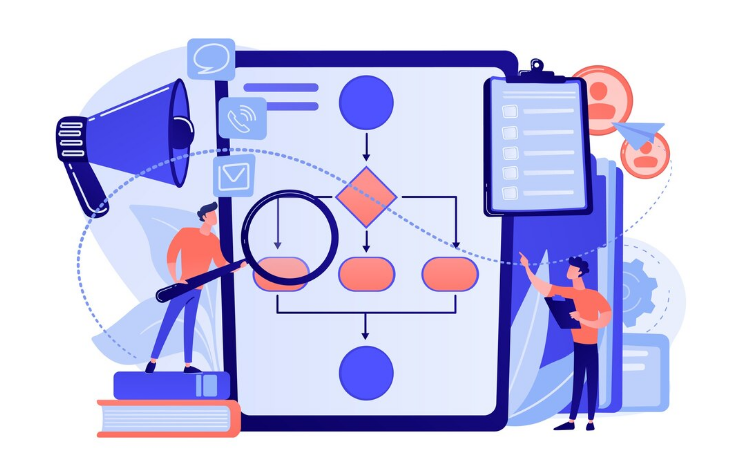
Professional book illustration is a collaborative process with defined phases. Understanding what happens at each stage helps you prepare, contribute effectively, and avoid the most common sources of delay and frustration.
Phase 1: Brief and Discovery
The process begins with a comprehensive creative brief. Your illustrator needs to understand: the book’s genre and audience, the overall tone and emotional feel you’re aiming for, the specific scenes, characters, or concepts that need to be visualized, any style references you’ve gathered, and any brand or identity considerations that need to be reflected in the artwork.
The more specific and visual your brief, the more efficient the illustration process will be. Illustrators are not mind-readers — they work from the information you give them. A detailed brief with reference imagery and specific direction produces better initial concepts and requires fewer revision rounds than a vague one.
Phase 2: Initial Concepts and Sketches
Your illustrator produces initial sketches or concept explorations — rough, small-scale drawings that establish the composition, character positioning, and overall visual direction without investing in full rendering. This is the most critical review stage. Feedback at the sketch phase is fast and inexpensive to act on. Feedback after full rendering is expensive and slow.
Review sketches carefully. Confirm that the composition, character expressions, and spatial relationships are right before approving the move to final artwork. This is also the time to flag any factual or contextual issues — a character’s appearance, a setting’s details — that would be harder to correct in the finished illustration.
Phase 3: Rendering and Color
With sketches approved, the illustrator moves to full rendering — adding detail, texture, and color to produce the finished artwork. For digital illustration, this is done entirely in software; for traditional media, the physical work is completed and scanned at high resolution for reproduction.
At this stage, feedback should focus on refinements rather than structural changes. Requesting a composition change at the rendering stage is expensive and disrupts the project timeline significantly. Trust the sketch approval process to catch large structural issues; use the rendering review for color, mood, and detail adjustments.
Phase 4: File Delivery and Print Preparation
Finished illustrations are delivered in formats appropriate for print and digital use: typically high-resolution TIFF or PNG files for interior illustrations, and layered source files for cover artwork that needs to be adapted for different formats (ebook, print-on-demand, audio, etc.). For print books, your illustrator or publishing team will ensure color profiles, resolution, and bleed specifications meet the requirements of your chosen printer.
Illustration Cost Overview
Illustration costs vary significantly based on the type of book, the scope of work, the illustrator’s experience, and the medium. Here is a realistic reference range for 2026:
| Scope of Work | Typical Cost Range (2026, USA) |
| Custom cover illustration only (no interior) | $800–$5,000+ |
| Children’s picture book (24–32 full-color spreads) | $6,000–$25,000+ |
| Board book (10–16 full-color spreads) | $3,000–$10,000 |
| Chapter book (spot illustrations throughout) | $2,000–$8,000 |
| Non-fiction interior diagrams / infographics (set of 10) | $1,500–$6,000 |
| Business book framework diagrams (set of 5–8) | $1,000–$4,000 |
| Character design and style guide | $800–$3,000 |
| Chapter header illustrations (set of 10–15) | $1,000–$3,500 |
These ranges reflect professional-quality work from experienced illustrators. Offshore rates may be lower, but quality, communication, and adherence to project briefs vary significantly. For a book attached to a serious publishing or professional brand, investing in a skilled, experienced illustrator is almost always worth the premium.
Frequently Asked Questions
How do I know if my book needs illustration?
The clearest indicator is your book’s genre and audience. Children’s picture books and illustrated chapter books require illustration by definition. For other categories, ask: would visual elements make this book significantly easier to understand, more emotionally engaging, or more competitive in its market? For most non-fiction, business books, and professional titles, the answer is yes for at least the cover and potentially for interior elements. A consultation with a publishing professional can help you assess the right scope.
Can I use AI-generated art instead of a professional illustrator?
AI-generated imagery can serve as a starting point for conceptual exploration, but it is not a substitute for professional illustration in published books intended for commercial distribution. Beyond quality and consistency limitations, AI image generation raises significant copyright and licensing questions that are still being resolved legally in the US and internationally. Professional publishers and distributors increasingly require confirmation that cover and interior artwork was created by human artists. For a book representing your professional brand, AI-generated art carries reputational risks that professional illustration does not.
How long does the illustration process take?
Timeline depends on the scope of work. A single cover illustration typically takes two to four weeks. A complete children’s picture book with 24–32 spreads typically takes three to five months. Non-fiction interior illustrations (diagrams, infographics) typically take four to eight weeks depending on complexity and volume. Build illustration timelines into your publishing schedule early — rushing illustration produces worse results and costs more in revisions.
Who retains the rights to commissioned illustration?
In a standard work-for-hire arrangement, the commissioning party (you, the author or publisher) owns all rights to the artwork upon full payment. The illustrator retains no rights to use the work commercially. This should always be explicitly confirmed in your contract before work begins. Some illustrators offer non-exclusive licensing arrangements at lower rates, which means they retain the ability to use the artwork in other contexts — typically not appropriate for book cover art.
How does Bookpress Publications coordinate illustration with the rest of the publishing process?
Bookpress Publications manages illustration as an integrated part of the full publishing process, not as a separate service to be coordinated externally. Our illustration team works alongside your editor and production team, so cover art is developed in alignment with your book’s marketing position, interior illustrations are timed correctly within the overall production schedule, and all artwork is delivered in the correct formats for your distribution channels. This integration eliminates the coordination overhead that comes from managing independent contractors across different stages of the process.
Art That Does the Work Before the Words Start
The illustration decisions you make for your book aren’t aesthetic choices in isolation — they’re strategic ones. The right cover illustration gets your book clicked on. The right interior art makes your ideas more memorable. The right character design creates the emotional connection that turns readers into fans.
In a publishing landscape where thousands of new titles are released every week, visual quality is not a secondary consideration. It is a primary competitive factor — and one that professional illustration services make accessible to every author at every level.
Bookpress Publications offers custom book illustration services for children’s books, non-fiction, professional titles, and cover design across all genres. Book a free consultation to discuss your book’s visual needs, explore illustration styles, and get a clear picture of what a professional illustration partnership would look like for your specific project.
Leave a Reply