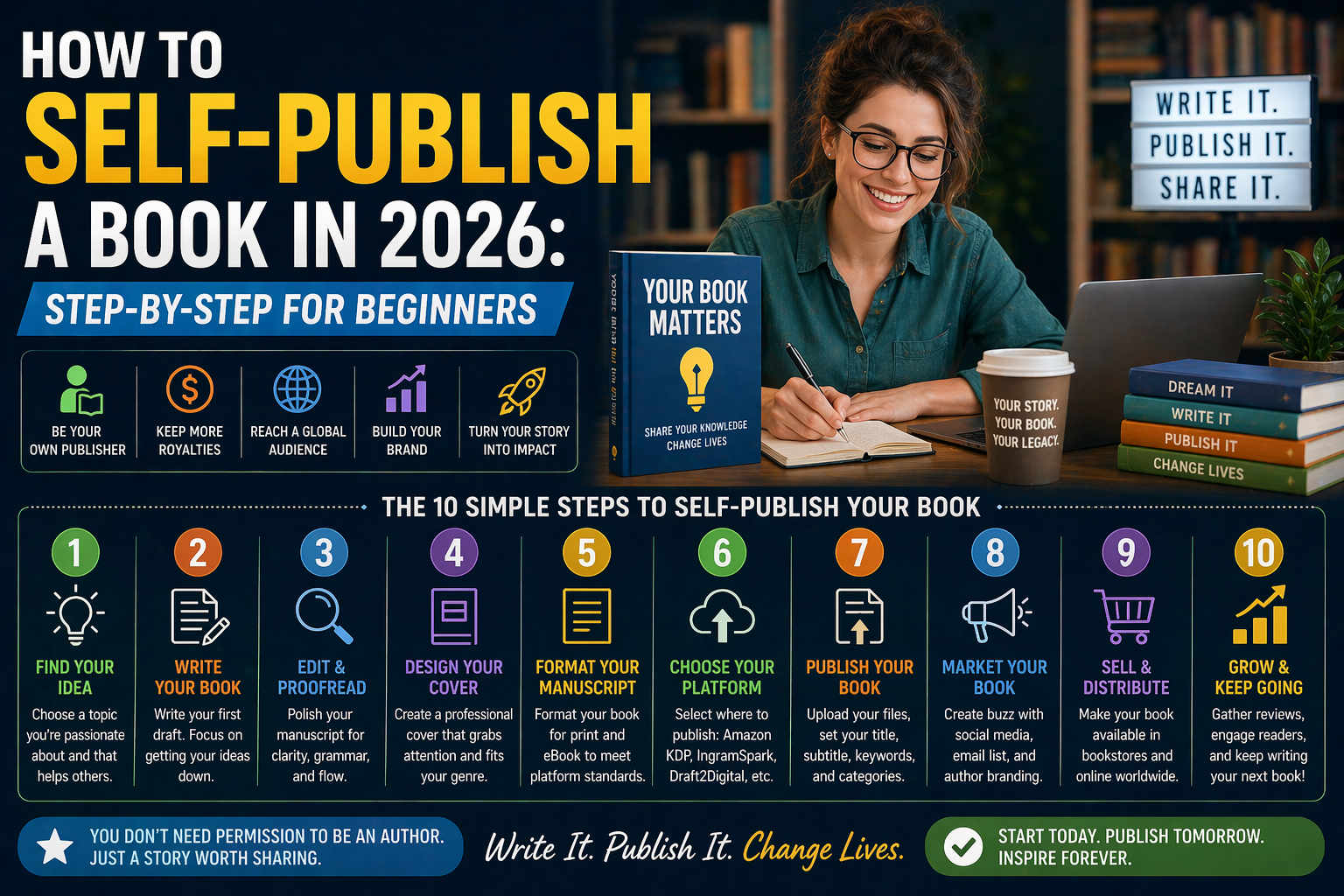
Self-publishing has never been more accessible — or more competitive. In 2026, anyone with a manuscript and an internet connection can upload a book to Amazon and call themselves a published author. But there’s a significant difference between uploading a file and publishing a book that actually reaches readers, earns reviews, and builds your reputation.
This guide is for first-time authors who want to do it right. We’ll walk through every step of the self-publishing process — from finishing your manuscript to getting your book in front of the right readers — with honest advice about where to invest your time and money, and where the common mistakes happen.
| What This Guide Covers This is a complete step-by-step walkthrough of self-publishing in 2026: manuscript preparation, editing, cover design, formatting, choosing your publishing platform, pricing strategy, and marketing your launch. No steps skipped, no fluff. |
Why Self-Publishing Is a Legitimate Path in 2026

The old stigma around self-publishing is gone. Some of the most successful authors in the world today are self-published, and the numbers back this up. Self-published authors on Amazon KDP can earn royalties of up to 70% on each sale, compared to the 10–15% typically offered by traditional publishers. They retain full creative control, keep all rights, and can publish on their own timeline.
That said, self-publishing success doesn’t come from simply uploading a Word document. Readers have high expectations. The books that succeed are the ones that look and read professionally — because they were produced professionally, even if the author did it independently.
Here’s exactly how to do that.
The 10 Steps to Self-Publishing Your Book
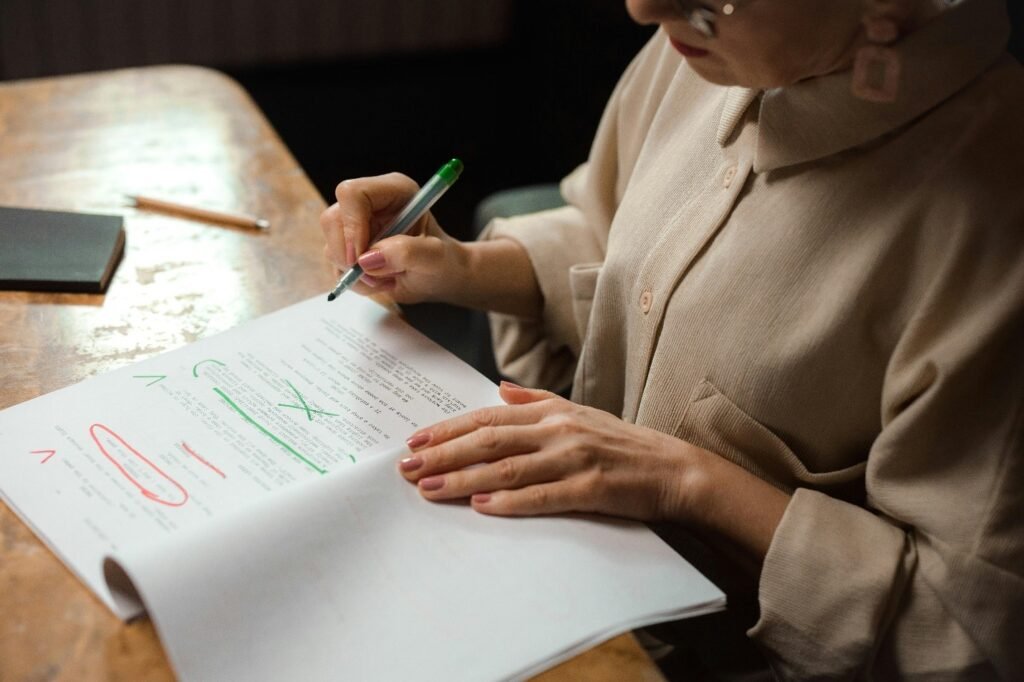
Let’s take a look at the 10-step process for self-publishing your book easily in 2026.
Step 1: Finish and Polish Your Manuscript
Before anything else, your manuscript needs to be complete. This sounds obvious, but many first-time authors jump into cover design or marketing before the writing is actually done. Resist the temptation. A finished, clean draft is the foundation everything else is built on. Write to the end, then do a full read-through before handing it to anyone. Fix obvious inconsistencies, remove filler sections, and ensure your beginning, middle, and end all deliver on the premise of your book.
Step 2: Get Professional Editing
This is the step that separates books people love from books they abandon after three pages. Professional editing is not optional if you want your book to compete. At minimum, your manuscript needs a copy edit (sentence-level clarity, grammar, consistency) and a proofread (the final clean-up before formatting). Ideally, you’ll also commission a developmental edit first — a structural review that looks at big-picture issues like argument flow, chapter organization, and narrative coherence. It’s the most expensive step, but it’s also the one that most directly determines the quality of the final product.
Step 3: Design a Professional Cover
Readers absolutely judge books by their covers. Research consistently shows that cover design is the number-one factor in a reader’s decision to click on or pick up a book. Your cover needs to do three things: communicate genre instantly, look professional at thumbnail size (because most readers first see it as a small image on Amazon), and stand out in your category. Do not attempt a DIY cover unless you have genuine graphic design experience. Hire a professional cover designer who specializes in your genre and understands how to design for the current market.
Step 4: Format Your Interior for Print and Digital
Formatting is what transforms your edited Word document into a book. Print formatting involves setting trim size, margins, fonts, chapter headers, page numbers, and other interior layout elements. Digital formatting (for ebook versions) requires a separate process that produces a reflowable file compatible with Kindle, Apple Books, Kobo, and other platforms. Poor formatting is one of the most common complaints in reader reviews of self-published books — widows, orphans, inconsistent spacing, and clunky chapter breaks all stand out immediately. Use a professional formatter or a publishing service that handles this step as part of their package.
Step 5: Choose Your Publishing Platform(s)
In 2026, your two primary self-publishing platforms are Amazon KDP (Kindle Direct Publishing) and IngramSpark. Amazon KDP gives you access to the world’s largest book retailer and is where most self-published books generate the majority of their sales. IngramSpark gives you access to a wider distribution network — including brick-and-mortar bookstores, libraries, and international markets. Many authors use both. If you publish exclusively on KDP, you can opt into KDP Select (which gives you access to Kindle Unlimited) but you must agree to exclusivity for 90-day rolling windows. Consider your audience, your goals, and your marketing strategy before deciding.
Step 6: Get Your ISBN and Copyright
An ISBN (International Standard Book Number) is your book’s unique identifier in the global book market. You can purchase your own ISBN through Bowker (the official US ISBN agency), or you can use the free ISBNs offered by Amazon KDP or IngramSpark. The important caveat: if you use a platform’s free ISBN, that platform is listed as your publisher of record. Buying your own ISBN means Bookpress Publications — or your own imprint name — appears as the publisher. For professionals building a serious author brand, owning your ISBN is worth the cost.
As for copyright: in the United States, your work is automatically copyrighted as soon as it’s created. However, registering your copyright with the US Copyright Office gives you additional legal protections and the ability to sue for statutory damages in the event of infringement. Registration costs $35–$65 and is strongly recommended.
Step 7: Set Your Price Strategically
Pricing a self-published book requires balancing your royalty rate, your genre’s market norms, and your launch strategy. For ebooks on KDP, pricing between $2.99 and $9.99 earns you a 70% royalty. Below $2.99 or above $9.99, your royalty drops to 35%. Most successful self-published fiction ebooks are priced between $3.99 and $5.99. Non-fiction and professional books often command higher prices — $9.99 to $14.99 for ebooks is common. For print books, calculate your production cost through KDP’s royalty calculator and price accordingly, ensuring you make at least $1–3 per print sale after printing costs.
Step 8: Build Your Author Platform Before You Launch
The biggest mistake first-time self-publishers make is treating marketing as something you do after the book is published. By then, you’re starting from zero. Your author platform — your email list, your social media presence, your website, your relationships with reviewers and communities in your genre — should be built before launch day. Start at least three months before your publication date. Build a simple author website with a newsletter signup. Start sharing your writing journey on the social platforms where your readers are. Connect with book bloggers, reviewers, and communities who will genuinely want to read your book.
Step 9: Launch With a Strategy
A book launch is not an event — it’s a campaign. The most effective self-publishing launches in 2026 include several coordinated elements:
- An ARC (Advance Review Copy) program: send free early copies to readers in exchange for honest reviews on launch day
- A price promotion or free Kindle Countdown Deal in the first week to boost your visibility in Amazon’s algorithms
- A coordinated social media and email push on launch day and throughout the first two weeks
- Outreach to relevant podcasts, blogs, and publications in your niche for features, interviews, and reviews
- Amazon advertising to amplify organic discovery immediately post-launch
The goal in the first 30 days is momentum — reviews, sales velocity, and visibility all feed each other on Amazon’s algorithm. A strong launch creates a self-reinforcing cycle that drives long-term discoverability.
Step 10: Market Your Book Consistently After Launch
The launch is just the beginning. The books that succeed long-term do so because their authors treat marketing as an ongoing commitment, not a one-time event. This means maintaining your Amazon advertising campaigns, continuing to build your email list, regularly engaging with readers, and looking for new opportunities for features, reviews, and promotion. If your book is part of your professional brand, every speaking engagement, podcast appearance, or media mention should reference it. Consider enrolling in Kindle Unlimited if your genre’s readership skews to subscribers. And always be working on your next book — because the best marketing for a book is another book.
The Most Common Self-Publishing Mistakes to Avoid

Even with the best intentions, first-time self-publishers routinely make the same errors. Here are the ones that hurt most:
- Skipping or under-investing in editing — no amount of great marketing rescues a poorly edited book
- Using a DIY cover that signals ‘amateur’ to every reader who sees it in search results
- Publishing before the manuscript is truly ready — you only get one first impression with your launch audience
- Ignoring metadata — your book’s title, subtitle, description, and categories determine whether readers find it
- Setting a price too low to seem accessible, then earning nothing per sale
- Treating the launch as the finish line instead of the starting gun
| The Shortcut Worth Knowing Working with a full-stack publishing service like Bookpress Publications means you don’t have to navigate any of these steps alone. From editing and design to publishing setup and launch strategy, our team handles the complexity so you can focus on what only you can do — share your story and expertise with the world. |
Self-Publishing vs. Working With a Publishing Service: Which Is Right for You?
True DIY self-publishing gives you the highest level of control and, if you do everything well, the highest royalty rate. But it requires significant time investment, a willingness to learn multiple new skills, and the ability to manage multiple vendors and deadlines simultaneously.
For first-time authors — especially professionals, executives, and entrepreneurs who are writing to build their brand rather than to pursue a writing career — working with a professional publishing service typically produces a better book, faster, with far less stress.
Think of it this way: you wouldn’t handle your own legal work because you technically could. You hire a professional because their expertise produces a better outcome in less time. Publishing your book is no different.
Frequently Asked Questions
How long does it take to self-publish a book?
From a completed manuscript to a published book, the minimum realistic timeline is about three months — two for professional editing and design, one for formatting, platform setup, and launch preparation. Rushing the process almost always results in a lower-quality final product. If you’re starting from a rough draft or need ghostwriting, add two to four months before editing begins.
How much does it cost to self-publish a book?
Done properly, self-publishing a book in the United States costs between $2,000 and $10,000 or more, depending on manuscript length, editing depth, illustration requirements, and marketing investment. The single biggest costs are professional editing and cover design. Budget generously for both — they are the two factors that most directly impact how readers perceive and respond to your book.
Do I need a literary agent to self-publish?
No. Literary agents are relevant to the traditional publishing path, where they represent authors to publishers in exchange for a commission on deals. If you’re self-publishing, you’re bypassing the traditional publishing gatekeepers entirely, so no agent is needed. You deal directly with the publishing platforms, your service providers, and your readers.
Can I self-publish and sell my book in bookstores?
Yes, through IngramSpark’s distribution network, your self-published book can be made available to bookstores, libraries, and retailers worldwide. However, getting bookstores to actually stock your book on their shelves requires additional effort — including a returnable distribution arrangement, a professional cover and interior, and often a direct relationship with the store or a publicist. Most self-published authors generate the majority of their sales online.
What’s the difference between self-publishing and vanity publishing?
Self-publishing means you’re independently managing (or hiring professionals to manage) your book’s production and distribution, with you retaining all rights and royalties. Vanity publishing refers to companies that charge authors to publish their book without providing genuine editorial or creative quality. The distinction matters: a reputable full-stack publishing service like Bookpress Publications delivers professional standards at every stage. Vanity publishers take your money and produce a substandard product. Always ask to see examples of published books before signing with any publishing service.
Your Book Is Within Reach
Self-publishing in 2026 offers every author the opportunity to reach readers, build a brand, and share their message without a traditional publisher’s gatekeeping. The path is accessible — but the authors who succeed are the ones who approach it with the same professionalism they’d bring to any serious business endeavor.
That means investing in quality editing, professional design, smart distribution, and a marketing strategy with real teeth. It means treating your book as the business asset it is, not a side project you’ll get to whenever there’s time.Ready to publish your book the right way? Bookpress Publications offers a free initial consultation to map out your publishing roadmap, identify exactly what your manuscript needs, and show you how our full-stack team can take you from where you are to a professionally published book — without the guesswork.
Leave a Reply